



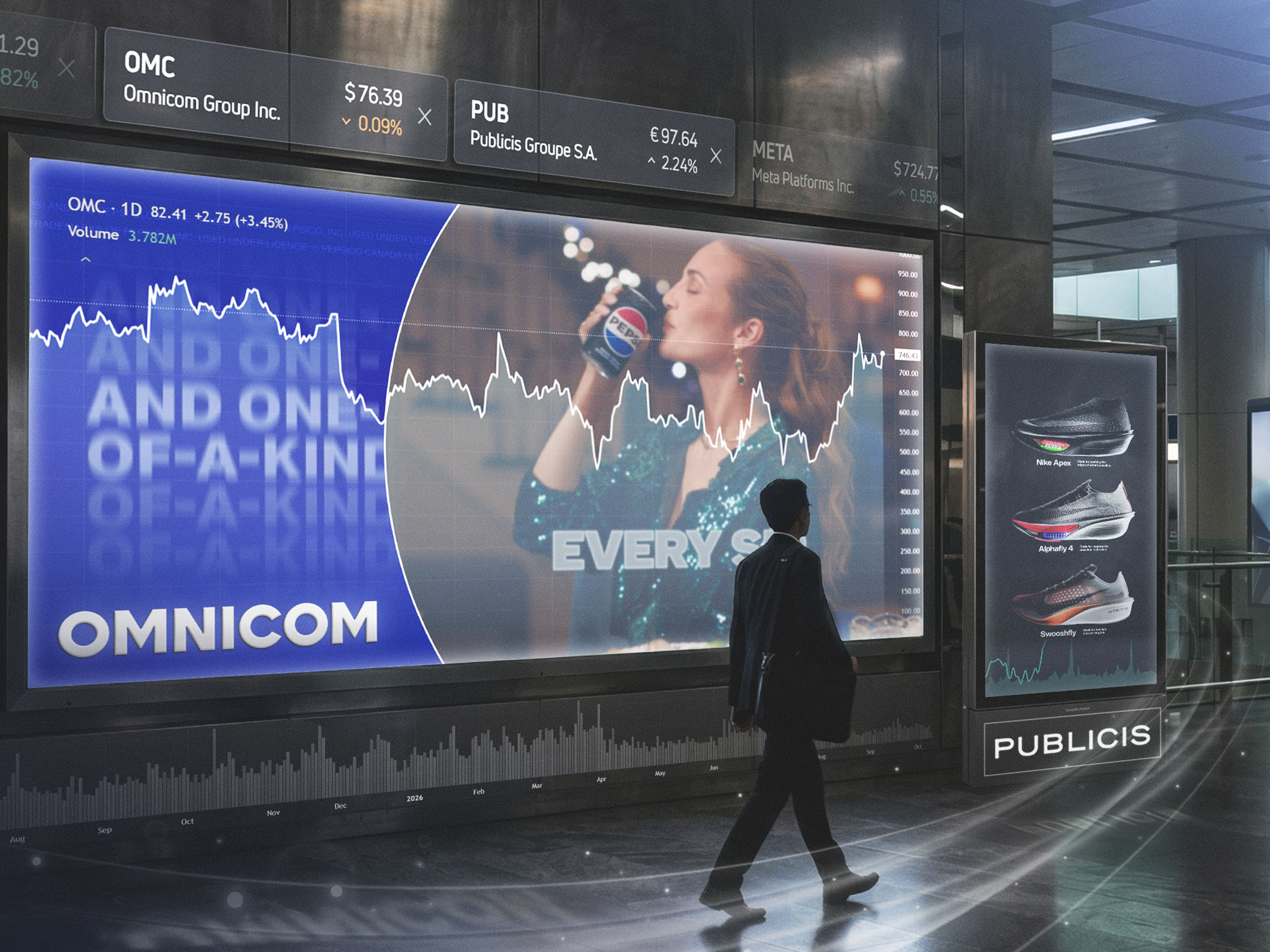


The digital revolution of the past 20 years has upended the advertising industry just like so many others, pushing ads from newspapers and linear TV to the Internet.
But that hasn’t hurt New York City-based Omnicom (NYC: OMC), the world’s biggest advertising holding company, and Paris-based Publicis (CBOE: PUB), no. 2. Both companies also engage in marketing and public relations.
Their size has helped both adapt to the explosion of digital advertising, though Publicis has adjusted more quickly. Digital ad spending as a percentage of total ad spending has surged from 40% in 2016 to 70% recently.
“Ad agencies now need to incorporate data analytics offerings to compete in a larger, more fragmented, and more complex advertising market,” Morningstar analyst Michael Hodel wrote in a commentary.
“Most excess value accrues to the largest, closed platforms, Meta (NASDAQ: META), Amazon (NASDAQ: AMZN), and Alphabet (NASDAQ: GOOGL). The shift to digital requires significant quantitative expertise in media planning and buying for an increasingly interconnected and global audience.”
‘Well positioned’
And that’s exactly what Omnicom and Publicis provide. “Both Publicis and Omnicom are well positioned, thanks to their customer identity data, scale, and reputations within the industry,” Hodel said.
He particularly likes Publicis because of its 2019, $4.4 billion purchase of identity-graphing-data stalwart Epsilon. Its abilities have generated “top-of-class” organic growth for Publicis since 2019, Hodel said.
Omnicom has made important acquisitions of its own. It bought Flywheel Digital, a retail transaction data company, for $835 million in 2024. And it added agency competitor Interpublic Group for $8.9 billion in 2025 to increase its size while improving personal identity graphing solutions and precision marketing capabilities.
“Flywheel will enhance Omnicom’s visibility into purchases in digital marketplaces,” Hodel said. By boosting Omnicom’s scale, the IPG deal “should lead to better discounts when purchasing advertising space…. [And] IPG’s Acxiom identity graphs has even more upside.”
The additions will help give Omnicom “an industry-leading identity solution that competes with Publicis’ Epsilon,” he said.
So both companies are building their AI capabilities. Omnicom says it integrates 2.6 billion verified consumer IDs through trillions of signals and digital transaction data. Similarly, Publicis connects 2.3 billion consumer profiles and retail media data via its identity engine.
Solid earnings
As for earnings, Omnicom’s organic revenue for core operations rose 6.1% year-on-year in the second quarter to $6.6 billion. Adjusted EBITA from core operations soared by more than six times, and the related profit margin increased to 17.8% from 15.9%.
Looking at Publicis, its net organic revenue gained 4.8% year-on-year in the second quarter, with total net revenue at 3.54 billion euros (US$3.96 billion). Its operating profit margin was 17.4%, unchanged from a year ago and tops in the industry.
“We have yet to see any meaningful AI disruption of the agency revenue model,” wrote Morningstar analyst Mark Giarelli.
“Scope expansion suggests that rising volumes and experimentation are offsetting any AI-related fee pressure, while continued margin expansion indicates that costs are receding faster than fees are compressing.”
Publicis stock has outperformed Omnicom in recent years, given its quicker adjustment to the digital deluge. The former’s stock has generated a total return of 19.7% in the last year and an annualized return of 14.4% over the last five years. Omnicom’s returns are negative 2.1% and positive 3.4% for the same periods.
Now it looks like both companies may have the strength to produce solid returns.


Comments