



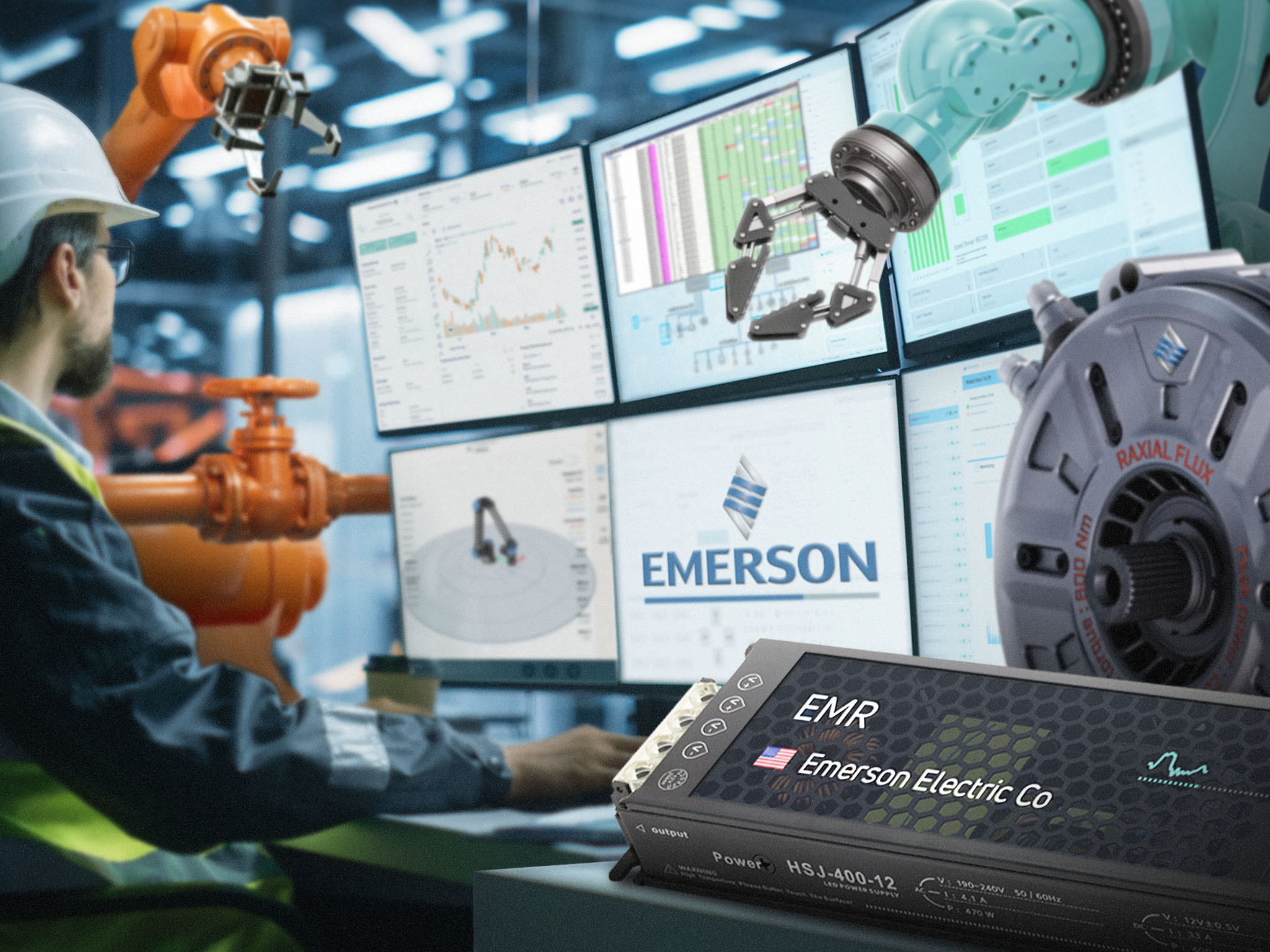


Automation represents perhaps the most important development in the industrial sector over the past decade, enabling manufacturers to produce more efficiently and cheaply.
And no company is more on the forefront of automation than Emerson Electric (NYSE: EMR). “It is the undisputed powerhouse in process manufacturing on the west side of the Atlantic,” Morningstar analyst Nicholas Lieb wrote in a report.
“The firm is poised for several years of positive organic growth on the heels of secular trends driving the adoption of factory automation products, such as rising global safety standards and the widening shortage of skilled labor.” The spread of data centers, of course, creates tremendous demand for Emerson’s products.
It makes industrial automation hardware, software, and precision measurement tools to help factories and plants run safely and efficiently. It helps machines and assembly lines operate with minimal human help.
Its smart sensors measure pressure, temperature, liquid flow, and gas levels. Its control systems and software monitor and run complex plant processes. Its valves and actuators are heavy-duty parts that control or stop the flow of liquids and gases inside pipes.
Intelligent Devices account for 55% of the company’s revenue, Software & Systems for 33% and Safety & Productivity for 12%.
Automation is where it’s at
Many analysts see automation as the strongest part of Emerson’s business. “Because control-level software and equipment oversee an entire plant’s automation system and integrate with multiple layers of the automation pyramid, their malfunctioning can be much more destructive than floor-level component errors,” Lieb said.
“Control-level products have heightened performance requirements and switching costs stemming from their cost of failure, complex integration, and employee training costs.”
Emerson’s main automation brands are DeltaV and Ovation for hardware and software and AspenTech just for software. “They have a near-ubiquitous presence across many hybrid and process industries and consistently boast renewal rates exceeding 95%,” Lieb said.
DeltaV is used by 24 of the top 25 global drug makers, and Ovation is used in 60% of U.S. power generation. AspenTech is used by 19 of the 20 biggest global oil companies and 19 of the 20 largest chemical companies.
Switching costs for users of Emerson equipment is high. “It performs niche functions within complex processes that often face rigid regulatory requirements and operate in extreme environments,” Lieb said. The price for ripping out mission-critical equipment and replacing it is high.
Latest earnings
The company’s revenue climbed 7% in the quarter ended June 30, adjusted earnings per share jumped 13% and the pre-tax profit margin surged to 18.8% from 16.1%. Emerson has enjoyed returns above its cost of capital going back at least until 2009.
To be sure, the company isn’t without flaws. Its Safety & Productivity segment has been a drag on revenue growth, with sales increasing just 2% year-on-year in the latest quarter, compared to 11% for Software & Systems.
Lieb also isn’t too impressed with some of Emerson’s structural decisions. For example, management put its Safety & Productivity unit under review in November 2024 but has apparently decided to keep it. That’s a mistake, he says. “The segment is non-core and would be better off being divested so that Emerson can focus on its core automation portfolio.”
Lieb also criticized Emerson’s $8.2 billion purchase of National Instruments, a provider of software-connected automated test and measurement systems, in 2023. “We are skeptical that National Instruments fits in Emerson’s automation portfolio,” he said.
There’s no automated process for corporate success, of course. But Emerson seems to be doing well so far.


Comments