



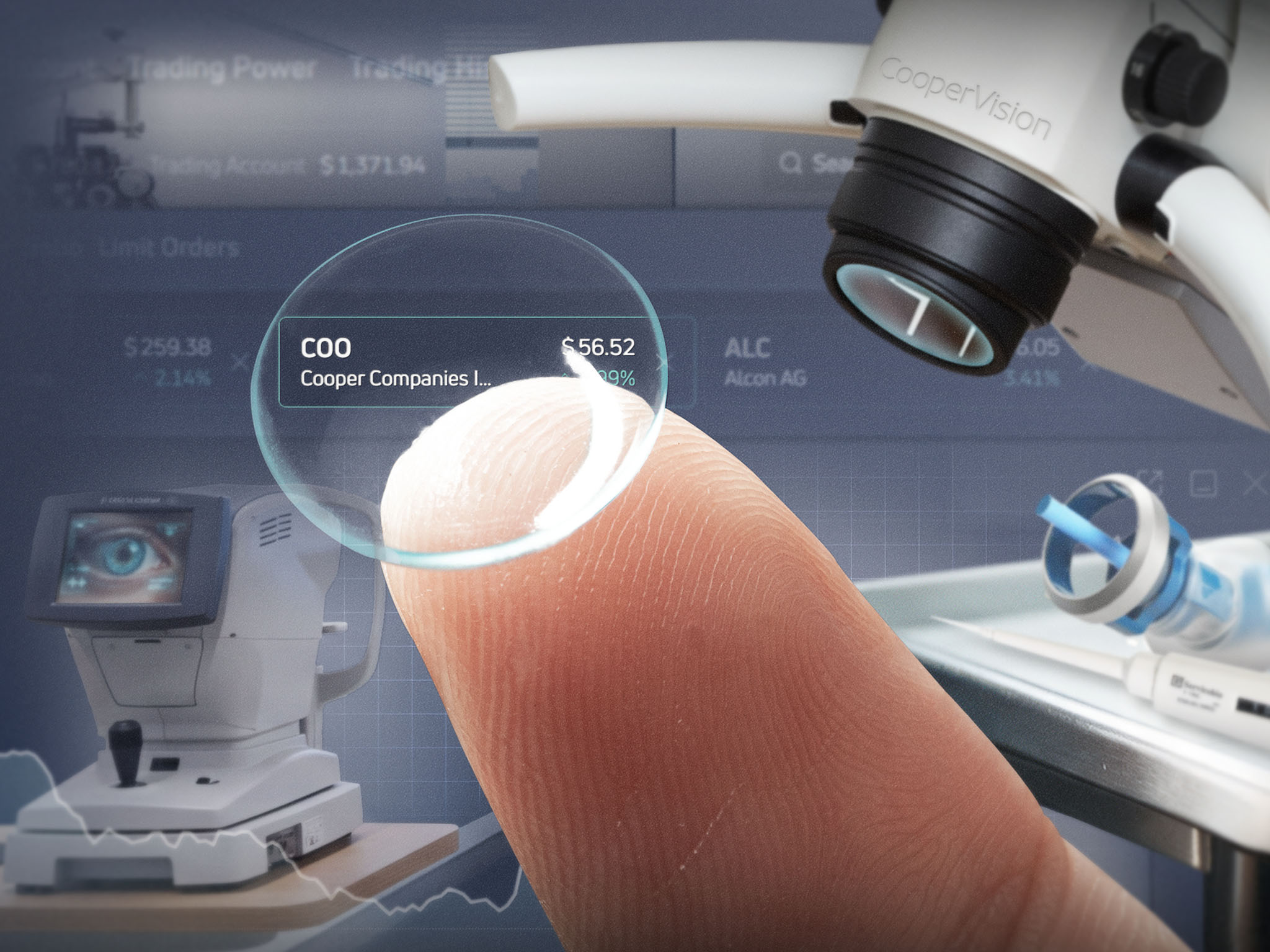


CooperCompanies (NASDAQ: COO), a supplier of contact lenses and women’s medical devices, is a company with both great strengths and weaknesses.
It has two divisions. CooperVision, a pure-play contact lens business, accounts for about two-thirds of revenue. And CooperSurgical, which includes fertility and gynecological surgery devices and technology, makes up the rest.
Analysts are impressed with much about the contact lens unit. It has a 25% market share, tying Alcon (NYSE: ALC), and trailing only Johnson & Johnson (NYSE: JNJ) at 33%.
“Cooper’s contact lens business benefits from intangible assets due to superior products, the company’s continued investment, and brand power,” Morningstar analyst Keonhee Kim wrote in a commentary.
He noted that Cooper devotes about 4% of revenue to research and development, enabling investments in new technologies such as MiSight 1 Day. That’s the first government-approved daily soft contact lens to correct children’s myopia.
Cooper has other outstanding contact-lens products too. “Its patented Aquaform technology, a technique used in its Biofinity (monthly) and Avaira (biweekly) families, makes softer and more flexible lenses by implementing high oxygen transmissibility and a low modulus into its lenses,” Kim said.
Gaining market share
Thanks to its strong product development, CooperVision has been able to increase its share of a generally stagnant market by mid-single digits since 2014, Kim explained.
“Cooper bolsters brand power through clinical and technical improvements in its products,” he said. “It fosters practitioner preference with scientific evidence proven by clinical studies, often spanning years.”
There is a major switching cost for Cooper lens users too. The way it works in the U.S. is that people with vision problems go to an eye doctor to get diagnosed, and then the doctor makes a lens recommendation. The doctor must write a prescription for a specific brand of lenses before the patient can buy them.
“Each contact lens fits differently, and material behavior is different with all soft lenses,” Kim said. “So once someone finds contact lenses that they enjoy wearing without any issues, it is highly likely that they will stick with the same ones year over year. On average, a patient sticks with the same contact lenses for seven years.”
Despite all this strength, Cooper’s stock has generated an annualized return of negative 21% for the last year and negative 11% for the last five years.
The weak link
Analysts and investors aren’t wowed by CooperSurgical. “No one device or specific service that CooperSurgical offers materially differentiates itself from others,” Kim said. Indeed, activist investor Jana Partners has urged CooperCompanies to sell the fertility and medical device businesses of CooperSurgical.
Jana also wants the company to consider selling CooperVision or merging it with a competitor, perhaps Bausch + Lomb (NYSE: BLCO). Jana has particularly called out CooperVision for its weak inventory management.
The unit had to destock bloated inventories at its U.S. customers in the quarter ended July 31, pushing what would have been 5% year-on-year revenue growth for the Americas region to a decline of 2%. And the impact is continuing this quarter, Cooper said.
“While we view destocking as temporary, management also cited weak execution stemming from an underbuilt salesforce and marketing organization,” Kim said. “We view this as a bigger challenge, as rebuilding these capabilities could take considerably longer.”
Revenue as a whole climbed 1% year-on-year in the latest quarter, and adjusted earnings per share gained 4%. But Jana thinks the company’s problems are bad enough to call for a new CEO.
So Cooper looks like a classic case of glass half-empty or glass half-full.


Comments