



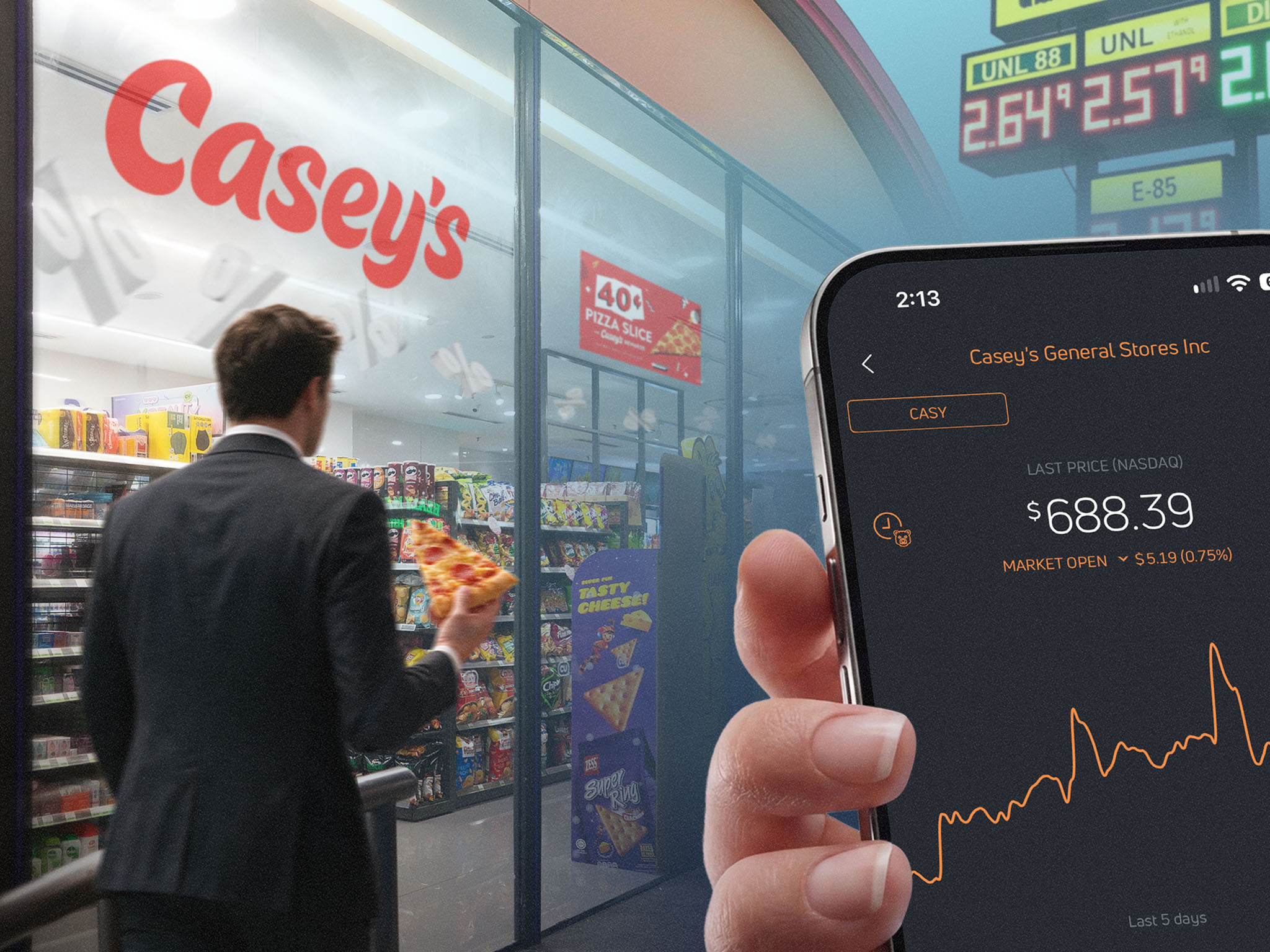


If you’re a big-city dweller in the U.S., there’s a good chance you’ve never heard of Casey’s General Stores (NASDAQ: CASY), the country’s third largest convenience-store chain. (7-Eleven is first and Alimentation Couche-Tard’s Circle K is second)
But people in rural areas of the Midwest and South are plenty familiar with Casey’s, which also has a major pizza business in its stores. It has almost 3,000 stores in those regions, with more than 70% of them in towns with less than 20,000 residents.
“Casey’s enjoys geographic insulation that national chains find uneconomical to replicate,” Morningstar analyst Brett Husslein wrote in a commentary. “This entrenched rural footprint provides durable utility, allowing Casey’s to serve as both an essential local staple and the nation’s fifth-largest pizza chain.”
The company has a hybrid model that includes grocery store, gas station, quick-service restaurant and general merchandise. Analysts are impressed with Casey’s execution of that model.
It has a cost advantage and superior intangible assets, “evidenced by inside-store gross profit that fully covers store operating costs before fuel, unlike 70% of its peers,” Husslein wrote in a commentary.
Vertical integration helps
Casey’s vertically-integrated supply chain gives it a firm advantage. It self-distributes 90% of its inside-the-store goods through its three distribution centers. The company buys products in bulk directly from manufacturers and then stores them in its warehouses. That cuts out the middlemen used by most convenience stores.
Casey’s also has its own fleet of delivery trucks that transport everything from tobacco and candy to fresh pizza ingredients directly to its stores. It also has a tanker fleet that transports about 60% of its fuel directly to its gas stations. That shields Casey’s from the supply disruption and price volatility that dogs players in this market.
All these strengths give Casey’s “structural cost advantages that fragmented peers lack, with subscale operators representing about 80% of the industry,” Husslein said.
Meanwhile, prepared food should remain a competitive advantage, he and others maintain. “Casey’s has built a credible quick-service restaurant proposition around pizza while expanding into wings, sandwiches, bakery, and coffee,” Husslein said.
“We think a broadened offering supports traffic and mix, but competition should intensify as traditional convenience operators add kitchens and branded food concepts while limited-service chains expand into rural markets.”
Rising market share
Casey’s share of inside-the-store sales will rise to 4.1% over the next decade from 2.8% currently, Husslein forecasts. That will be fueled by 3% increase in store count and value-oriented menu innovation, he said.
To be sure, Casey’s is expanding past its rural base, with 29% of stores in towns above 20,000 residents, up from 15% 15 years ago. It faces more competition where its local density and brand relevance are less dominant, Husslein explained.
But he remains bullish on the company, predicting an average annual return on invested capital of 15% over the next 10 years, easily topping his 8% cost of capital estimate.
Casey’s revenue soared 24% year-on-year in the quarter ended July 31, and net income jumped 20%. Inside-the-store profit margin climbed to 42.2% from 41.9%.
Investors have noticed the company’s sterling performance. The stock has generated annualized total returns of 20% for the last year, 37% for the last three years and 30% for the past five years. That trounces the performance of the S&P 500 Retail Index.
Still, Husslein thinks the gains have made the stock 70% overvalued. So you may want to proceed cautiously.


Comments