



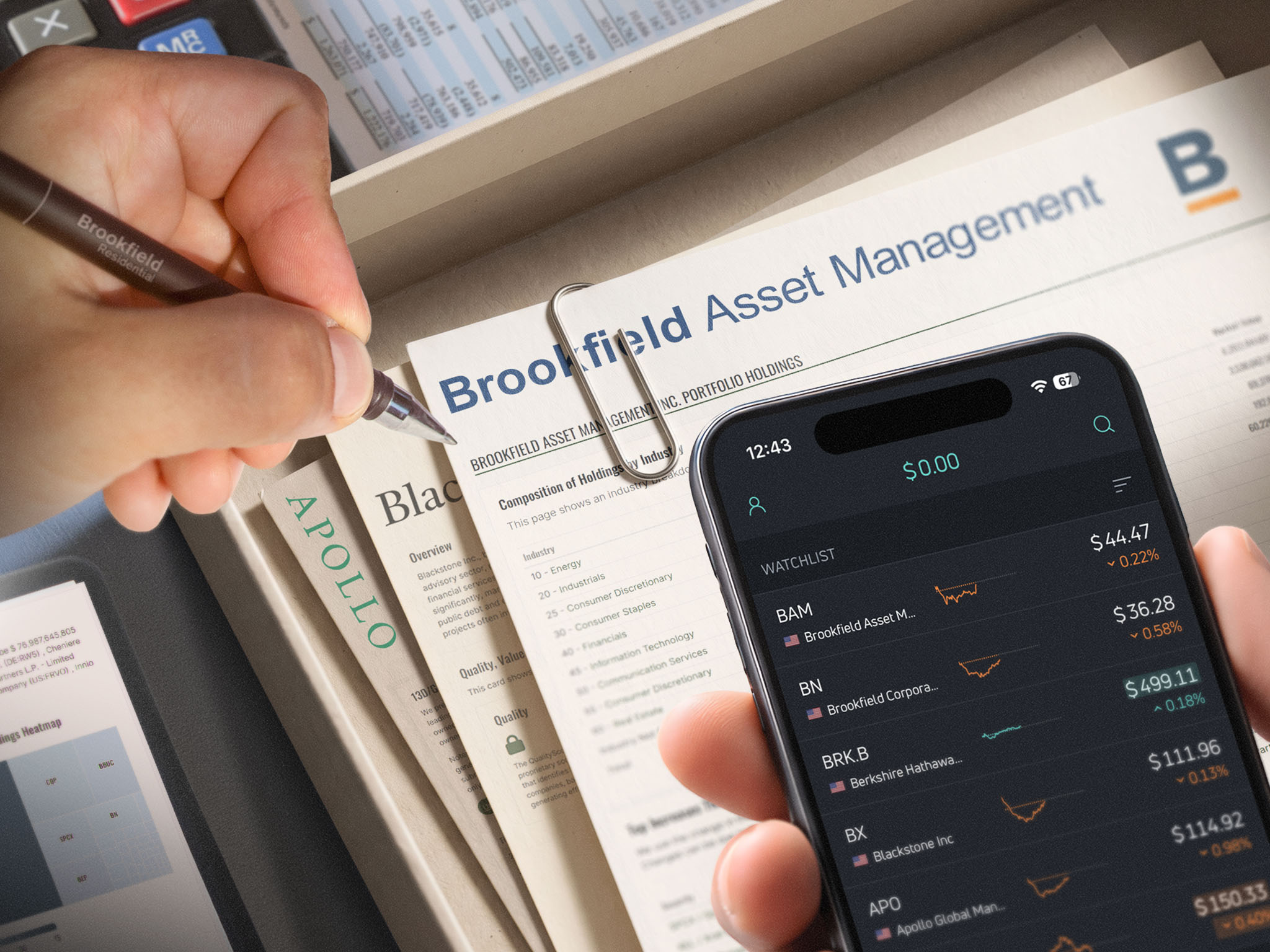


Canada’s Brookfield Asset Management (NYSE: BAM) receives scant attention next to fellow alternative asset heavyweights such as Blackstone (NYSE: BX) and Apollo Global Management (NYSE: APO).
But Brookfield is No. 2 in the field for assets under management (behind Blackstone), with $1.268 trillion as of June 30. And it has a solid performance track record.
Over the past 30 years, BAM’s 73%-owner Brookfield Corp. (NYSE: BN) has seen its stock climb at a 19% annual rate, with earnings up at a 13% rate, according to Barron’s. BAM went public four years ago, and its annualized total return is 13.7% for the last three years.
“BAM has built a strong position in the alternative-asset management industry,” Morningstar analyst Greggory Warren wrote in a report. “It relies on its reputation, broad product portfolio, strong investment-performance history, and a cadre of dedicated professionals.”
Strong demand for alternative assets from institutional and wealthy individual investors in recent years has allowed BAM to cash in on those strengths. And now the industry is trying to get average retail investors involved.
Company details, Berkshire resemblance
The company’s three main divisions are real estate/real assets with $686 billion of AUM, alternative credit with $416 billion and private equity with $166 billion. While that mix provides some diversification, “ultimately, we’d like to see a bit more,” given the dominance of real estate and private credit, Warren said.
Fee-related earnings jumped 19.5% in the second quarter year-on-year, and fee-earning assets grew 19.4%. Fundraising hit a quarterly record.
BAM has some similarities with Warren Buffett’s Berkshire Hathaway (NYSE: BRK.B). First, Brookfield Corp. has an insurance division that helps to finance BAM’s investments, just like Berkshire. They both seek to hold their investments for long periods, and they are both value-oriented investors.
One of BAM’s top plays was its 2023 acquisition of a 51% stake in Westinghouse, the leading provider of nuclear services to utilities. The investment could produce a six-times return for BAM, notes Barron’s Andrew Bary.
He also cited a successful growth investment by BAM. It invested $325 million in Elon Musk’s Space Exploration Technologies, or SpaceX (NASDAQ: SPCX). It now owns $1.3 billion of stock, after unloading $200 million worth.
Heady returns seen
BAM’s investment prowess and growing investor demand for alternative assets will help lead the company to an average annual return on invested capital of 45.6% from 2026 to 2035, Warren forecast. That’s well above his 10.7% estimate for cost of capital over that period.
However, continued strong success isn’t guaranteed for BAM. “Increased competition from peers is likely to drag on results over time,” Warren said. That includes more traditional asset managers like BlackRock (NYSE: BLK), which is making a strong move into the space.
In addition, the entire alternative-asset universe could suffer from a blowout in one of its asset classes, say private credit, which consists of many risky loans. Or the stock market could tank, dragging other markets down with it.
But things look good for BAM at the moment. “Brookfield has a differentiated portfolio geared toward hard assets and is positioned for success,” said Bart Dziarski, an analyst at RBC Capital Markets, as cited by Barron’s.


Comments