




The big new thing for beer drinkers is no-alcohol (NA) varieties, as consumers seek healthier beverages.
In the U.S., NA beer sales surged 159% in dollar terms from 2021 to 2025, according to NIQ (NielsenIQ). That pushed NA to 2.25% of total beer sales by volume in 2025, doubling from 1.1% in 2021.
Analysts expect the trend to continue. The Business Research Company forecasts 10.2% compound annualized growth for global NA beer sales through 2030, with the total reaching $38.7 billion. Society’s focus on health is likely to intensify, driving more consumers away from alcohol.
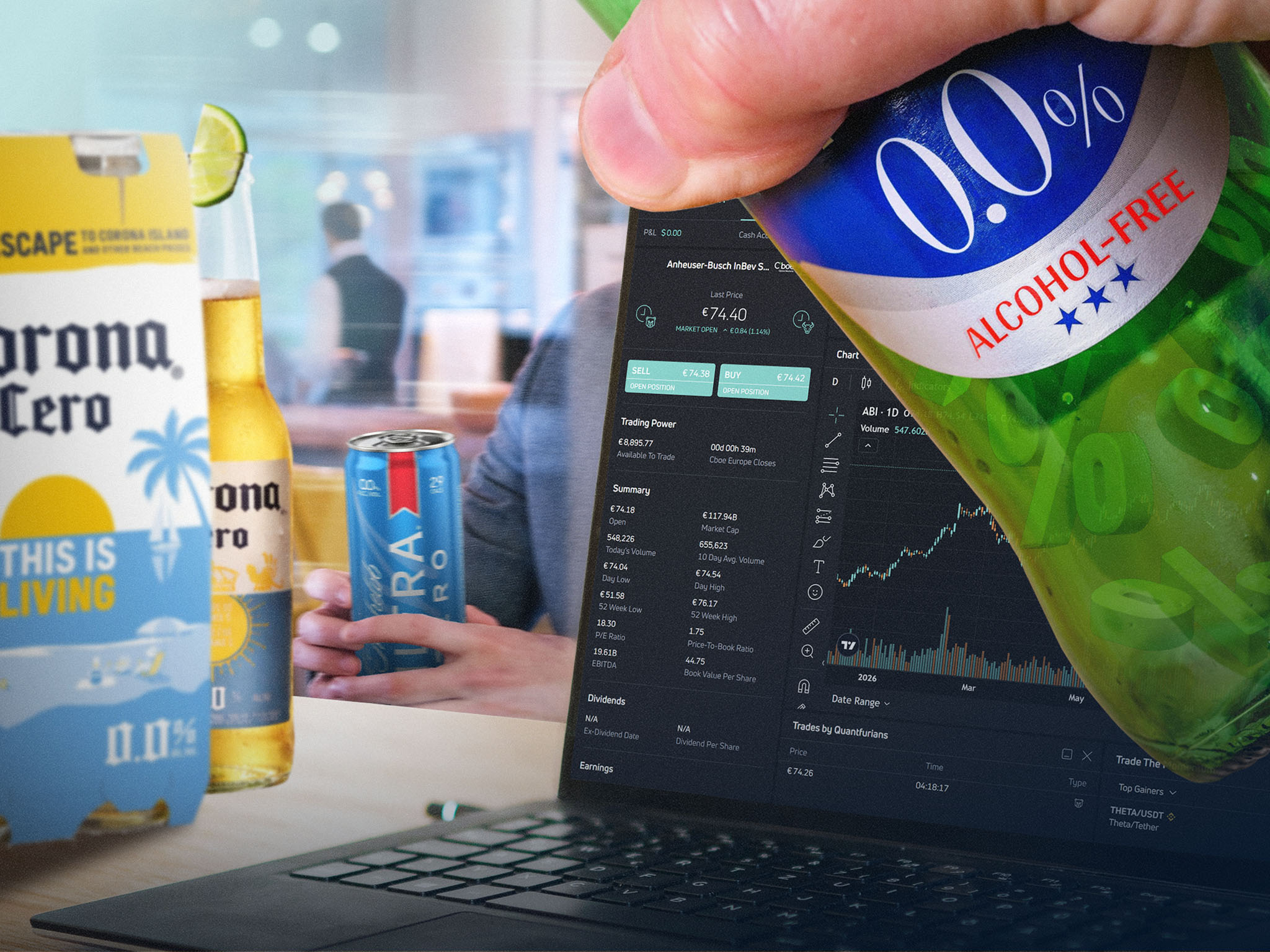
No one has benefited more from the move to zero than Anheuser-Busch InBev (CBOE: ABI), the world’s largest brewer, which supplies Corona and Budweiser, the world’s two biggest sellers in that order.
The company’s NA beer sales jumped 27% in the second quarter from a year earlier, easily topping the overall industry’s 11% increase in the first two months of the quarter. AB InBev is particularly focused on people drinking after athletic activity.
‘Well-placed’ for zero alcohol
The company doesn’t break out specific numbers for non-alcoholic beer sales. But Balanced Choices, which includes NA, low carbohydrate, low calorie, sugar-free, and gluten-free beer, accounts for 11% of total revenue.
“Early signs suggest AB InBev is well-placed to lead the battle for the zero-alcohol market,” writes George Glover of Barron’s. “It’s increasing revenue at a faster rate than its rivals, and has the dynamic brands to sustain that.”
The company’s top selling NA beers are Michelob Ultra Zero in the U.S. and Corona Cero globally. The former rose to its perch in February, just over a year after its launch. AB InBev is focusing its marketing campaign for the NA beers around sports, such as the soccer World Cup, where Michelob Ultra Zero was the official beer.
AB InBev and non-alcoholic beer specialist Athletic Brewing “will be the long-term winners” in this segment, Evercore ISI analyst Robert Ottenstein told Barron’s.
AB InBev can use the help. Its sales volume fell 1.7% in 2023, 1.4% in 2024, and 2.3% in 2025. Inflation weighed on sales, as did an ill-fated marketing program with transgender influencer Dylan Mulvaney, which hurt sales of Bud Light. Weight-loss drugs and legalization of marijuana also have dulled demand for alcohol, Glover notes.
AB InBev’s competitors, such as Heineken (CBOE: HEIA) and Carlsberg, have endured weak sales too. Sales volume slid 1.2% for Heineken last year and 2% for Carlsberg.
Buoyant second quarter
To be sure, AB InBev’s organic revenue climbed 5.6% in the second quarter from a year earlier, with the World Cup and a weak year-ago quarter in the Americas lifting the number. Adjusted profit rose 23%.
The company’s stock produced an annualized total return of 35% for the last year, 17% for the last three years and 9% for the last five years.
Morningstar analyst Verushka Shetty has a positive outlook for AB InBev. “Its Beyond Beer investments and strong premium beer portfolio position the firm well to drive future growth,” she wrote in a commentary.
Beyond Beer includes ready-to-drink alcoholic beverages, hard seltzers and spritzers. The premium beers include Stella Artois, Corona and Michelob Ultra. So perhaps the NA beers could be included as part of that.
AB InBev has “industry-leading profit margins, excess returns on invested capital, and best-in-class cash conversion,” Shetty said. Strong cash conversion means InBev generates cash from sales far faster than it pays for its inventory and expenses.
So maybe no-alcohol beer can help AB InBev keep its edge.
The author owns shares of AB InBev.


Comments