



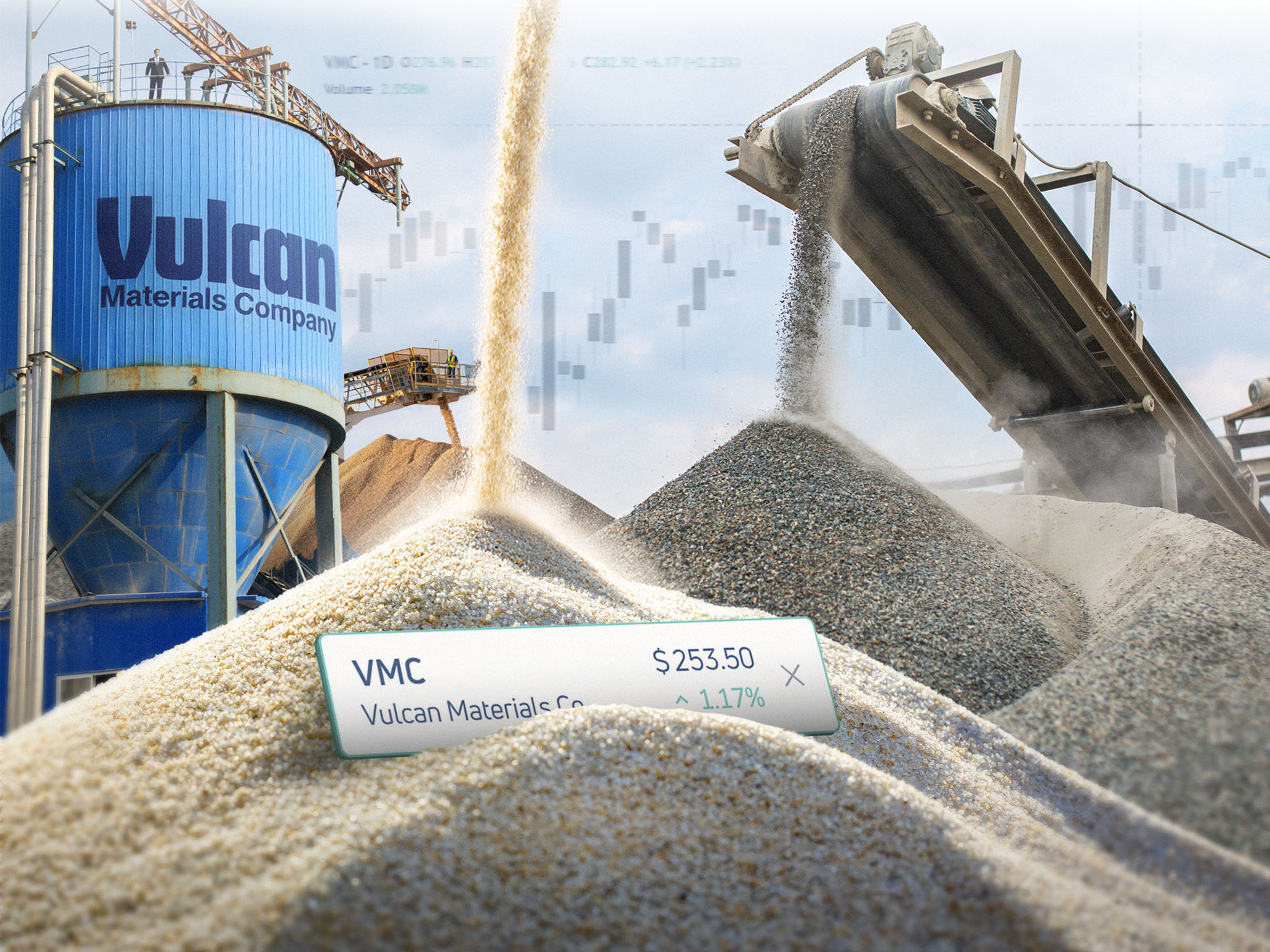


Vulcan Materials (NYSE: VMC), the No. 1 U.S. producer of construction aggregates, which are crushed stone, sand and gravel, has a crushing business model.
Aggregates represent about 75% of the company’s revenue, with asphalt and ready-mixed concrete making up the rest. Aggregates constitute the physical base of roads, bridges, homes, factories, and energy infrastructure.
Vulcan has a virtual monopoly on its quarries for aggregates, because permits are extremely difficult to obtain. Local communities often fight hard against quarry approvals because of concern about environmental impact and excessive noise. Vulcan’s near-monopoly has helped it vault to a No. 1 or No. 2 position in markets accounting for 90% of its revenue.
“Vulcan is really America’s tollbooth on concrete,” Todd Ahlsten, a portfolio manager at Parnassus Investments, told Barron’s. “Rocks are heavy and transportation costs matter. Vulcan owns rocks in the right places, giving it a geological moat, or a 50-year-plus reserve life, that is difficult, expensive, and often legally impossible to replicate.”
About 40% of Vulcan’s products go for public infrastructure, mainly highways, with the remainder going to the private sector. The public sector business provides a cushion when the private sector slumps. Governments like to sustain projects through downturns to buoy the economy and boost employment.
Room for price increases
The stability of demand throughout economic cycles has allowed Vulcan and its competitors to regularly increase prices, Morningstar analyst Nicholas Lieb wrote in a commentary.
The U.S. has a highly fragmented aggregates market, with more than 1,000 companies. “Many of these companies operate small, local operations that pale in comparison to Vulcan,” he said. “The low value/weight ratio of aggregates severely limits the range of deliveries and places importance on quarry locations.”
That gives Vulcan a transportation cost advantage, as its quarries are located closer to highly populated locations. The near-monopoly on quarry permits is crucial in that equation, keeping supply limited in Vulcan’s existing regions, Lieb notes.
All this is a big deal because building materials are commoditized, meaning companies need cost advantages to generate reliable profits, he said.
Vulcan registered decent earnings in the second quarter. Revenue climbed 2.5% from a year earlier. Aggregates produced the gain, compensating for declines in asphalt and concrete. Net income firmed 1%, and the adjusted EBITDA profit margin slid to 30.3% from 31.4%.
Earnings and stock underperform
That’s not too impressive in a U.S. construction market that is the strongest in 50 years. Construction spending soared 50% from 2020 to 2025. “Vulcan has struggled to grow its sales volumes,” Lieb said. “Price continues to be the main driver of top-line growth.”
In the second-quarter, Vulcan suffered from bad weather in the southern U.S., which encompasses most of its operations. It may be able to get that business back as weather improves.
Unsurprisingly, Vulcan’s mediocre earnings performance has been accompanied by sub-par stock returns. Shares have dropped 16% over the past year, and gained just 17% combined in the last three years.
But the future may bring better tidings. “It’s positioned well to benefit from the ongoing recovery of U.S. construction spending,” Lieb said. “We forecast strengthening demand growth for the public sector and modest growth for the private sector.”
So Vulcan may have built the foundation for success.


Comments