



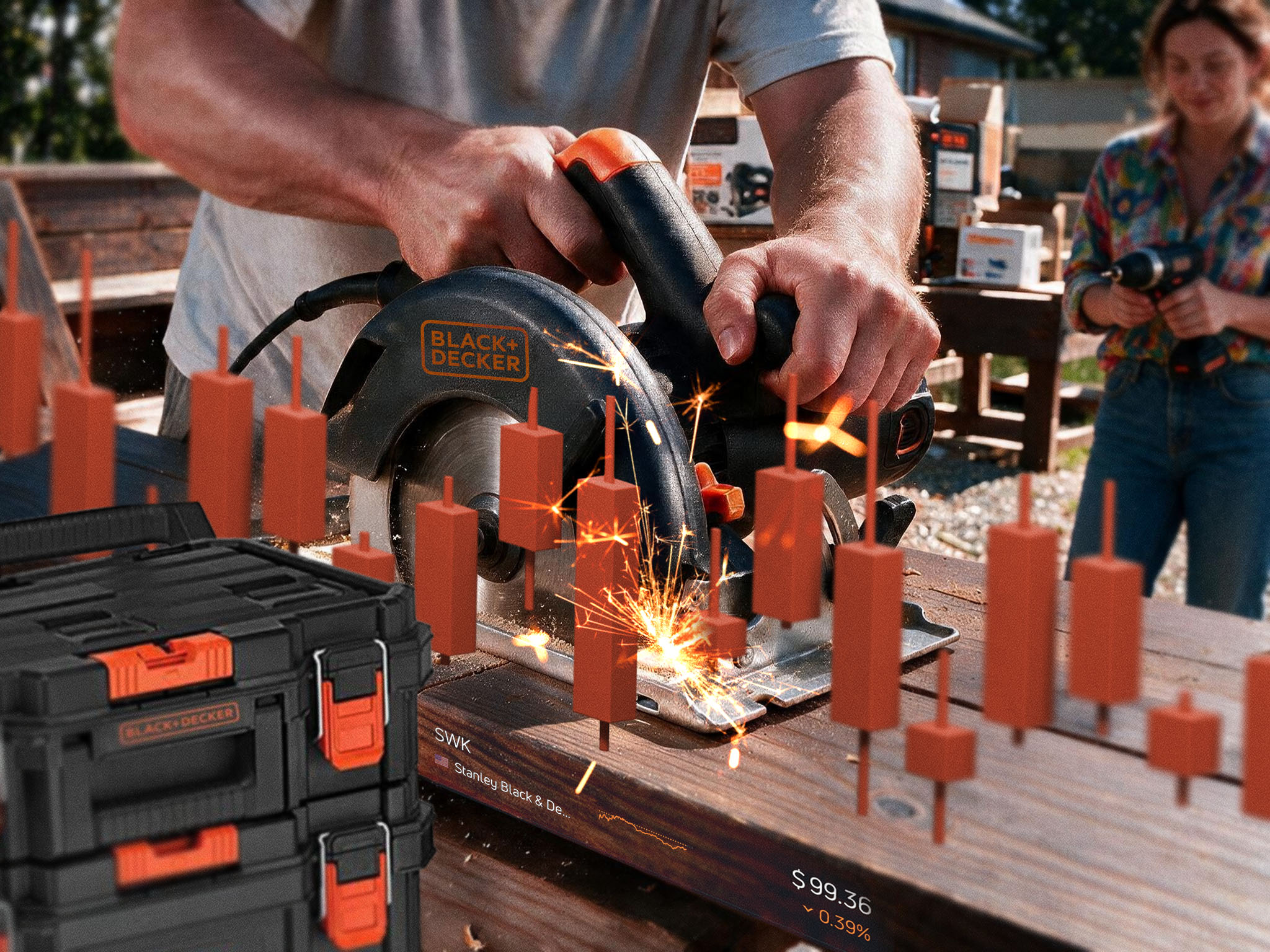


Consumer spending on do-it-yourself projects has rebounded as more people are buying tools from manufacturer Stanley Black & Decker (NYSE: SWK).
The company that makes industrial parts, screwdrivers and power tools under the popular brands of Dewalt, Craftsman, Stanley, Black+Decker and Cub Cadet, reported net revenue of $4 billion, an increase of 3% on an organic basis. Stanley Black & Decker reported earnings of $351.3 million or $2.33 a share, up from $101.9 million or 67 cents a share from a year ago.
The company increased its forecast for the year as its profit grew partially from tariff refunds that will be used for investments.
The maker of drills and other hand tools now expects 2026 earnings at $4.60 to $5.45 a share, up from a prior outlook of $4.15 to $5.35.
Shares of the company rose by 28% over the past year.
Revenue grows in tools and outdoor segment
In the tools and outdoor segment, net sales rose by 3% year over year as the division reported higher volume of a 3% increase. Revenue for North America sales rose by 3% on a total basis and up 4% organically while Europe was flat on a total basis and down 2% organically. The other countries reported revenue rose 8% on a total basis and up 3% organically.
Organic revenue was primarily driven by strength in the sales of power tools in the U.S. that were sold by retailers and from continued demand from professionals in the commercial and industrial channel, the company said in its second quarter earnings presentation.
Revenue rose by 8% in the power tools segment while the hand tools, accessories and storage organic division rose by 2%, “which were both driven by strong market activation and global priority brand performance,” said CEO Christopher Nelson during an earnings call. “Outdoor organic revenue decreased 7%, pressured by fewer replenishment orders as a result of weather-related demand softness.”
The tools and outdoor segment is “still expected to deliver low-single-digit organic growth in 2026, led by market share gains and what we anticipate will be a roughly flat to down market,” said CFO Patrick Hallinan during the earnings call.
But despite tariff refunds, “given inflationary pressures remain persistent, it appears more likely than not a price increase will be necessary by 2027,” he said.
Stanley Black & Decker’s tools are sold at large home improvement retailers such as Lowe’s and Home Depot, hardware stores and other retailers such as Target and Walmart.
The Home Depot accounted for approximately 15% and 14% of the company’s consolidated net sales in 2025 and 2024, respectively, while Lowe’s accounted for approximately 12% and 14% of the company’s consolidated net sales in 2025 and 2024, respectively, according to its 2025 annual report. Other customers did not exceed 10% of the company’s consolidated net sales in 2025 or 2024.
As of Jan. 3, 2026, the company, which is headquartered in New Britain, Connecticut, and its subsidiaries owned or leased significant facilities used for manufacturing, distribution and sales offices in 18 states and 21 countries, including 108 facilities that are larger than 100,000 square feet.
Revenue fell by 18% year over year in the engineered fastening segment due to the completed divestiture of the Consolidated Aerospace Manufacturing (CAM) business to Howmet Aerospace for $1.8 billion in cash. CAM provides fasteners, fittings, and other engineered components for the aerospace and defense industries. The net proceeds will be used to lower the company’s debt.
The deal drove revenue down by 21%, but was partially offset by volume rising by 2% and pricing increases by 1% while currency was flat. Organic revenue rose by 3%, driven by industrial strength and from continued automotive fasteners growth. Revenue rose by 7% in industrial and 2% in automotive.
Industrial construction ramps up
Construction projects have ramped up as the need for the buildout of data centers, power generation, and prefabrication manufacturing has risen, Nelson said.
Revenue from the U.S. commercial and industrial channel annual sales are estimated to approach 10% of total tools and outdoor sales in 2026, “assuming roughly double-digit organic growth this year,” he added. “Our ambition for DeWalt is to be the partner of choice for the professional end user. This means serving the full cycle of design, construction, and operations for large scale commercial projects.”
Stanley Black & Decker has been investing in the tools that professionals use because the projects they participate in “represent trillions of dollars of committed capital spending over the next five years,” Nelson said. “The expectations are demanding, the timelines are tight, and the owners and project managers have no tolerance for downtime.”
The company also plans to invest $1 billion in the U.S. to expand its manufacturing capacity and develop new products during the next two years. The company has been on a cost-cutting program since 2022 and has generated $2.1 billion of pre-tax run-rate savings, which is its original cost savings target.
Known for its well-crafted tools, Stanley Black & Decker’s products resonate and appeal to both consumers who embark on home improvement projects as well as professionals who are building the next data centers and power generation.


Comments