



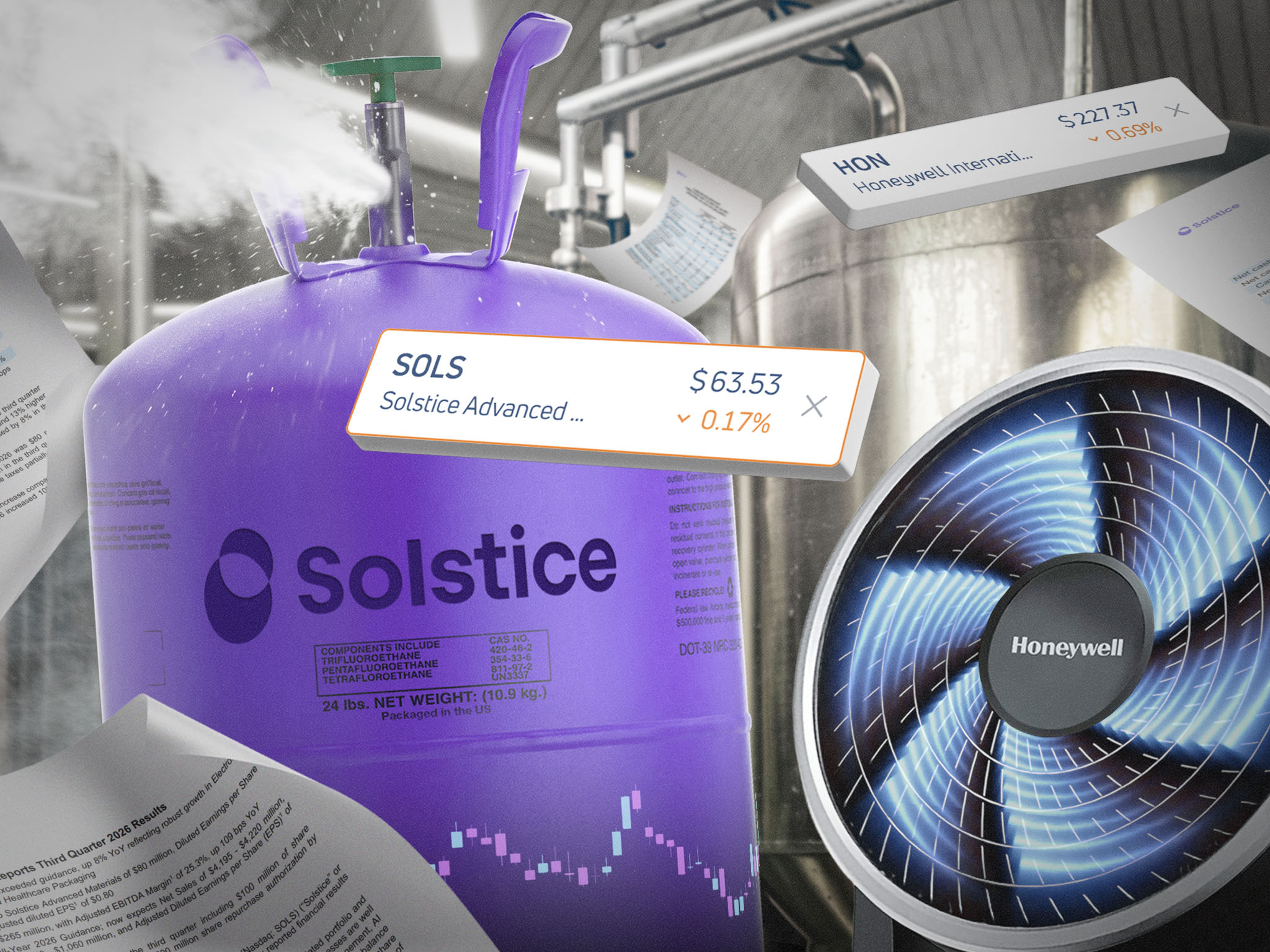


Solstice Advanced Materials (NASDAQ: SOLS), a specialty chemicals/materials maker, proves that spinoffs from larger companies can benefit the smaller company.
Solstice was carved out of then-industrial conglomerate Honeywell in October 2025. Its year-on-year revenue climbed 8% in this year’s third quarter. Its adjusted EBITDA gained 13%, and its adjusted EBITDA profit margin rose 109 basis points from a year ago to 25.3%.
The company has two units: Refrigerants & Applied Solutions, which accounts about 70% of revenue, and Electronic & Specialty Materials, which accounts for the rest. Refrigerants is Solstice’s biggest product, accounting for almost 40% of its revenue.
It sells the refrigerants to a wide range of industries, including autos, residential and commercial buildings and data centers. Solstice is a market leader in new hydrofluoroolefins (HFOs).
“HFO refrigerants are replacing hydrofluorocarbons (HFCs), as HFOs have far lower global warming potential than HFCs,” wrote Morningstar analyst Seth Goldstein. That’s because HFOs break down more easily in the Earth’s atmosphere.
Many governments have implemented regulations to phase out HFCs in favor of HFOs, including the U.S. and European Union, where Solstice garners most of its sales, he explained. “For Solstice, this creates a growing base of heating, air conditioning, and ventilation units, refrigerators, coolers, and autos that will require HFOs to be used for cooling.”
When it comes to brand-switching, “Solstice generally retains its customers because its HFOs are patent-protected in most end markets and regions for much of the next decade,” Goldstein said.
Building Solutions division
Building Solutions, the second biggest part of the Refrigerants & Applied Solutions division, is another important area for the company. “Its blowing agents are used to make insulation foams with low global warming potential,” Goldstein explains. Solstice products allow buildings to save energy and cut carbon intensity.
It also runs the only U.S. uranium conversion plant. It converts uranium ore into a gas required for nuclear enrichment. With nuclear power now in high demand, Solstice should benefit.
Turning to the Electronic & Specialty Materials division, Solstice’s semiconductor materials are a key player. “The company’s moat comes from its ability to help customers make smaller, more powerful chips, with new materials and the ability to provide greater levels of purity,” Goldstein said. Its chemicals and materials are used in deposition, etching, patterning, and packaging.
To be sure, Solstice has suffered stumbles. Its stock has tumbled 29% since June 30. On July 6, the company announced an agreement to buy peer Element Solutions for $14.5 billion. The plan was to build an advanced materials platform focused on AI infrastructure, semiconductors, and data-center cooling. Investors were turned off by the increased complexity in an industry that’s streamlining.
Investors also unloaded shares after Solstice’s strong third-quarter earnings report on Nov. 4, as part of its forward guidance trailed expectations. But the stock has recovered from that slide, and has ascended 29% year to date. Many analysts think it has further to go.
“We see a solid long-term outlook, which will be accelerated by management’s organic investment in the nuclear, electronics, and safety and defense segments,” Goldstein said. He sees revenue growing at a mid-single-digit annual rate over the next five years.
Solstice may indeed have the right chemistry.
The author owns Solstice shares.


Comments