


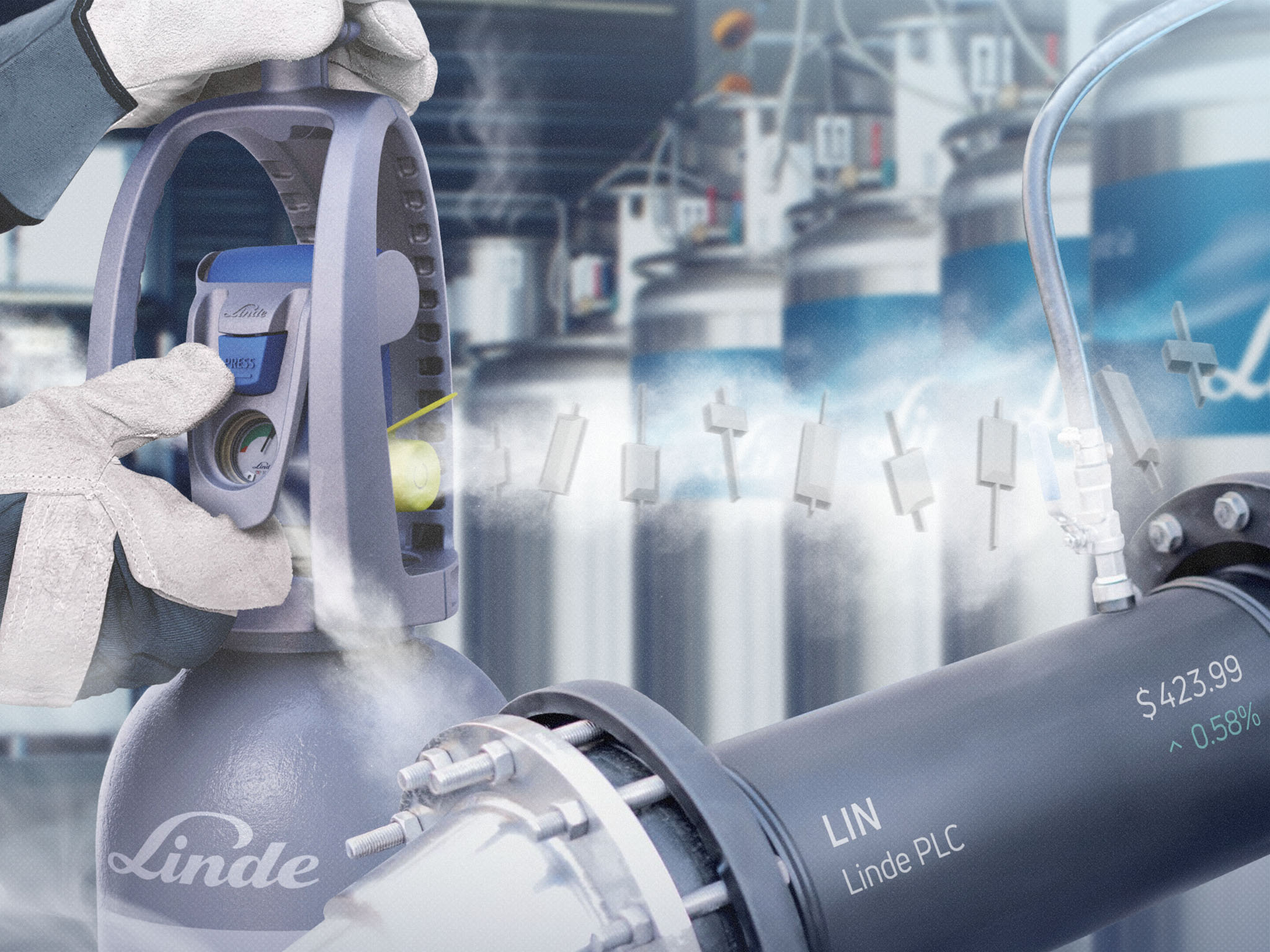


You probably don’t spend a lot of time thinking about industrial gases: they aren’t a particularly sexy segment of the economy.
But Linde (NASDAQ: LIN), the world’s largest industrial gas supplier, is a company worth looking at. It provides oxygen, nitrogen, hydrogen, carbon dioxide, and helium. It also provides equipment used in industrial gas production. Its customers include companies in chemicals, energy, food, beverages, electronics, healthcare, manufacturing, metals and mining.
The company has been able to withstand what it calls an industrial production recession over the past two years with superior execution. In the U.S., industrial output has gained just 0.4% during that period. Excluding engineering and an “other” category, 50% of Linde’s sales are in the U.S., 28% are in Europe the Mideast and Africa and 22% are in Asia Pacific.
The industrial sector’s weakness has limited Linde stock’s annualized total return to 1.9% for the past 12 months, 10.2% for the past three years and 11.7% for the last five years. That trails the S&P 500 index for all three periods, though Linde has beaten it over 10 years. The company has a market capitalization of $197 billion.
In any case, Linde is strong, experts agree. One big advantage: it’s part of an oligopoly with France’s Air Liquide (CBOE: AI) and Air Products (NYSE: APD). Together they control 70% of the world’s $120 billion market for industrial gases.
Stronger revenue numbers than competitors
But while Linde’s revenue rose 3% year-on-year in the latest quarter, Air Product’s revenue eased 0.6% and Air Liquide’s revenue slid 2.4%. Linde’s profit soared 24%, and its adjusted operating profit margin gained 10 basis points to 29.7%
Linde benefits from the wide diversity of industries it serves. So when demand falls from companies in cyclical industries like manufacturing and energy, Linde can compensate with demand from more stable industries like healthcare and food and beverage.
Food and beverage revenue is growing at low to mid-single digit percentage points year-over-year, “driven by a combination of consumption trends and innovative application technologies that enhance food quality and preservation,” Linde CEO Sanjiv Lamba said in the company’s Oct. 31 earnings call.
“This is a workhorse of the portfolio that may not get a lot of the spotlight but it provides consistent growth and is remarkably resilient.”
Customer demand
Another factor buoying Linde is that while Industrial gases typically account for a fraction of customers’ costs, they are a vital input to ensure uninterrupted production, writes Morningstar analyst Krzysztof Smalec. Meanwhile, Linde’s size and tight customer relationships give it pricing power.
So, “customers are often willing to pay a premium and sign long-term contracts to ensure that their businesses are running smoothly,” he said. And switching costs are high.
Looking forward, Linde plans to increase its business in the commercial space sector. It already furnishes industrial gases and infrastructure to more than 80% of U.S. commercial space launches.
“The opportunity to supply fuels for rocket launches, propulsion systems for placing satellites into orbits, it’s fueling double-digit growth in that market,” Lamba said in August.
So Linde is flying high in many areas. But demand for industrial gases is closely tied to industrial production. So until that increases it will be difficult for the company to go gangbusters. Still, it does have an order backlog of $10 billion, which should see it through sluggish conditions.


Comments