


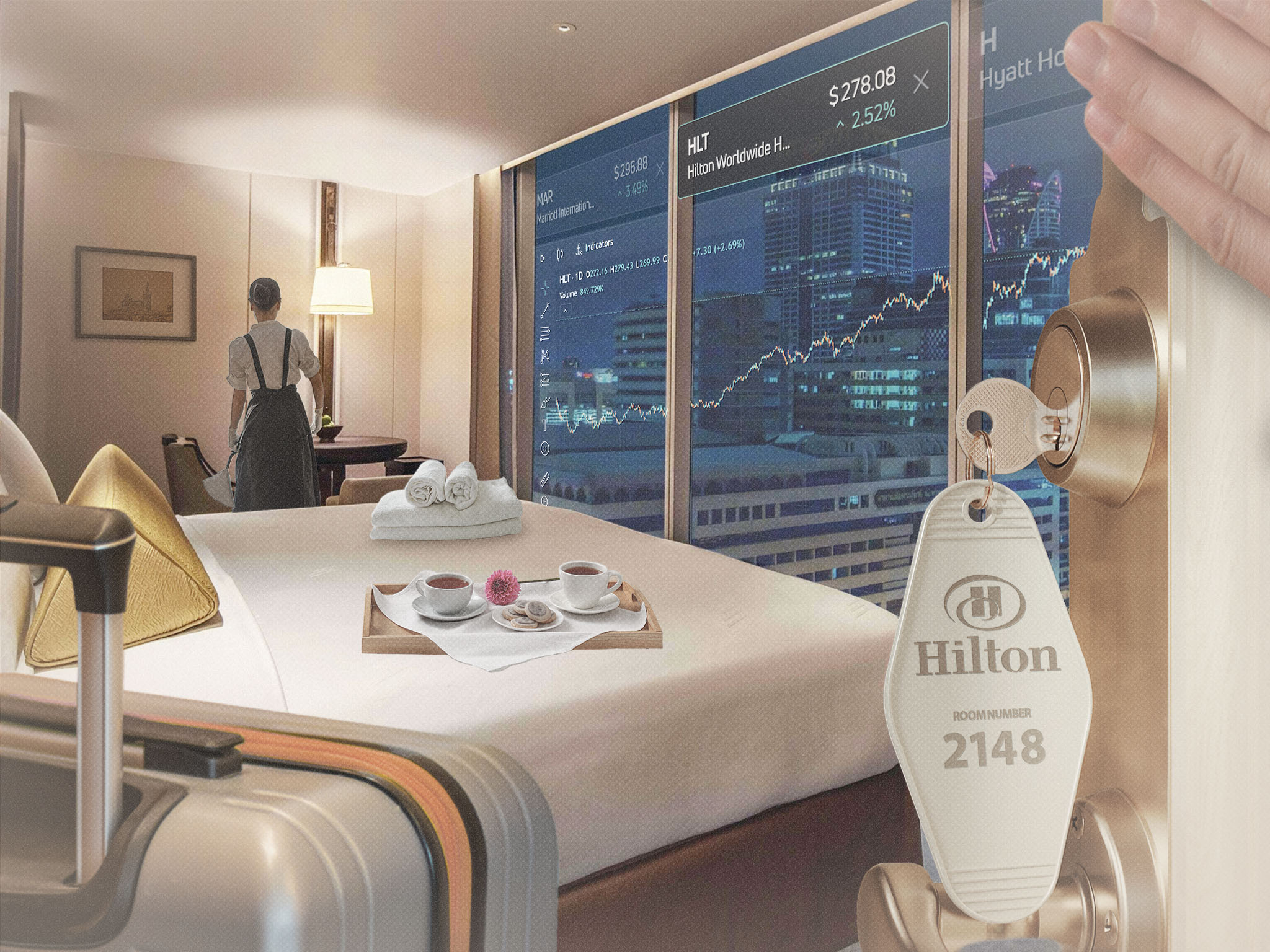


Hotel companies have rebounded with a vengeance from their 2020 Covid-induced meltdown amid the bounce-back of leisure and business travel.
Hilton Worldwide (NYSE: HLT) has easily led among the big three U.S. hoteliers’ stocks, with gains of 8.1% for the last year, 102% for the last three years and 168% for the last five years. That compares to 0.2%, 81% and 130% for Marriott (NASDAQ: MAR) and negative 0.9%, 62% and 122% for Hyatt Hotels (NYSE: H). Hilton also beat the S&P 500 for three years and five years.
Marriott is the largest of the titanic trio, with a market capitalization of $79 billion, followed by Hilton at $65 billion and Hyatt at $15 billion.
Hilton’ foundation is its strong brands, including luxury Waldorf Astoria hotels, upscale Hilton hotels, lifestyle Canopy hotels, moderately-priced Hampton hotels and extended stay Home2 Suites. “We see lasting demand for Hilton’s strong upper-scale, lifestyle, and luxury presence,” wrote Morningstar analyst Dan Wasiolek.
And the company isn’t resting on its laurels. It spent $6.7 billion last year on marketing, reservations, distribution, and loyalty, boosting its brand advantage. That number is multiples higher than most of Hilton’s competitors, he pointed out. Marriott is likely close, if not higher, but it’s numbers aren’t easily available.
Data-driven analysis
A slew of other data also point to Hilton’s strength. It has a mid-single-digit share of global hotel rooms, with more than 20% share of rooms under construction. Its net rooms growth rate was 7.3% last year, compared to 6.8% for Marriott. Hilton’s development pipeline totaled 39% of its inventory, compared to 18% for Marriott.
Hilton has a strong loyalty program, with 226 million members, though that trails Marriott with 260 million. Hilton’s members account for more than two-thirds of its room-night bookings.
All that leads Wasiolek to conclude that Hilton’s room-share expansion will be among the industry’s fastest over the next decade, averaging mid-single digits per year. That exceeds the 2% supply increase he projects for the U.S. industry as a whole.
Among Hilton’s newest brands are economy midsized offering Spark, and extended-stay LivSmart Studios brands, both launched in 2023.
As of Sept. 30, 2025, Spark already had 207 hotels open, with potential to reach a few thousand, Wasiolek said. And he estimates LivSmart had more than 100 hotels in the pipeline. In October this year, Hilton began a midsize lifestyle brand, Outset. It has 60 hotels in development and the potential to eventually add 500 properties in North America, he said.
Attractive business model
Hilton manages or franchises nearly all of its hotels. It doesn’t own them. That gives the company “an attractive recurring-fee business model with high returns on invested capital and significant switching costs for property owners,” Wasiolek notes.
Those hotels have low fixed costs and capital requirements, with contracts lasting 20-30 years. The contracts include significant cancellation costs for owners, keeping annual termination rates in the low-single digits, Wasiolek explains.
Hilton relies more on franchise fees (23% of 2024 revenue) than Marriott (12% of 2024 revenue). That means Marriott is more reliant on management fees, making Hilton the more asset-light company.
Wasiolek expects Hilton to outperform Marriott for the next few years in two key metrics. He
projects Hilton’s return on invested capital will average 22% during the 2024-29 period, with the operating profit margin expanding to 29.1% in 2029. Those numbers are 19% and 20.2% for Marriott.
So Hilton’s outlook looks as comfortable as its rooms.


Comments