



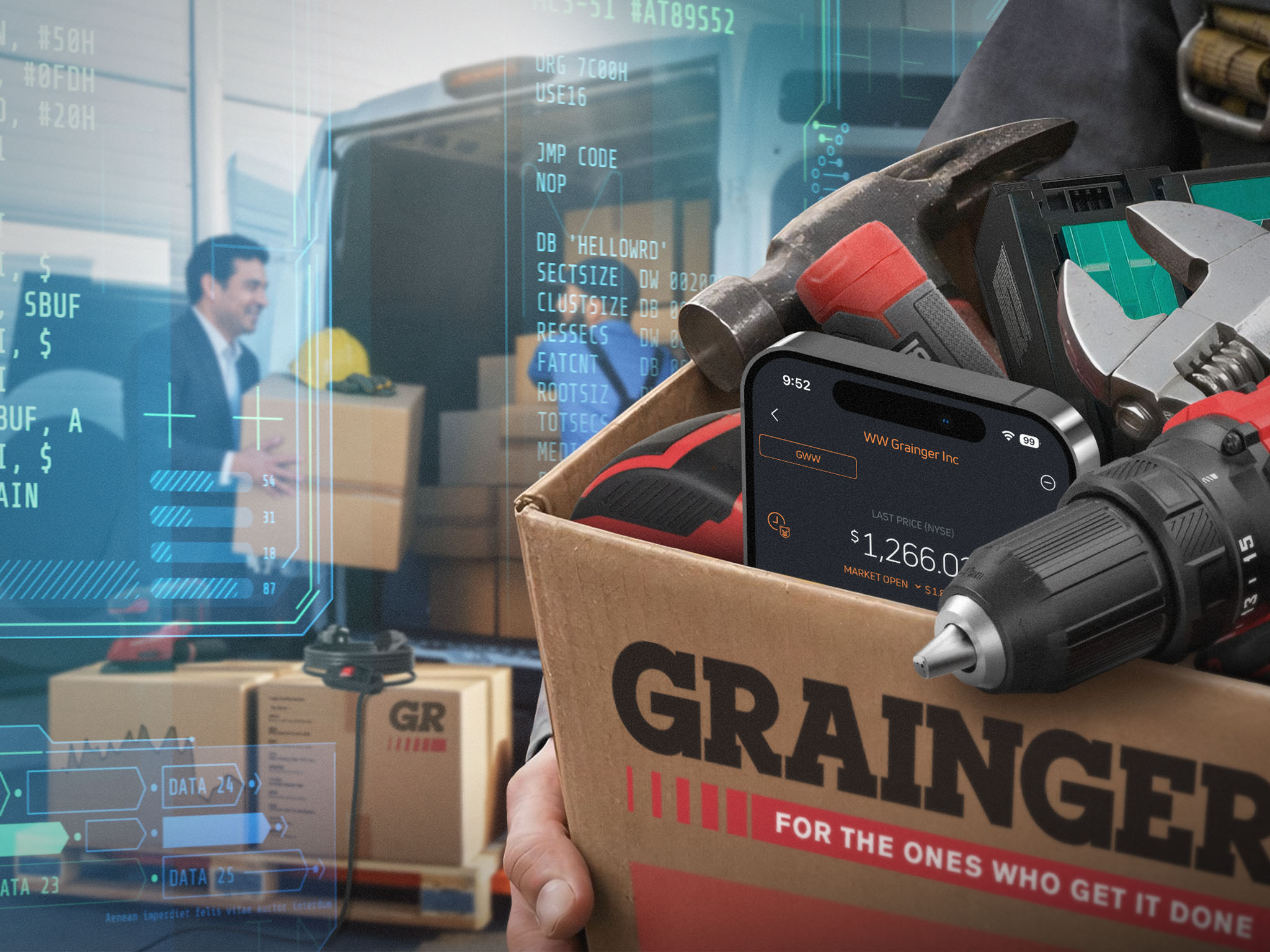


Industrial companies are often forgotten these days amid the hoopla for artificial intelligence and other technology.
But one industrial stalwart is W.W. Grainer (NYSE: GWW), the 99-year-old B2B distributor of maintenance, repair and operating (MRO) products and services.
It started as an electronic motor distributor and has since moved into a multitude other wares. The products now range from tools to plumbing equipment to HVAC and lighting equipment. And services range from inventory management (stockrooms, lockers and tool cribs) to safety management to electrical systems.
Grainger is the biggest player in the fractured, $140 billion North American MRO distribution market, with a 10% share.
That size is a key part of Grainger’s success. “Customers increasingly want fewer MRO suppliers that can combine broad assortment, reliable fulfillment, digital procurement, and inventory management,” Andrew Choi, director of research at Parnassus Investments, told Barron’s.
“Grainger’s scale lets it meet those needs while generating efficiencies it can reinvest in better prices, availability, and service.”
The company’s investment in technology has been particularly successful, analysts agree. Customers’ increased preference for online buying has led Grainger to devote extensive resources to improve its e-commerce capabilities and restructure its distribution network.
Making use of AI
It has been adept in its use of AI, analysts say. Grainger uses AI to consolidate customer data, deliver insights to its field sales units and identify prospective contacts. Grainger equips human customer service workers with generative AI tools to rapidly pull data from massive product catalogs instead of using fully automated bots.
It acquired technology, intellectual property, and talent assets from Adroit Worldwide Media for $210 million in August to advance automated inventory management and smart distribution capabilities.
“Grainger is using its product and customer data to improve search, make its sales force more productive, and automate inventory management,” Choi said. “It doesn’t hurt that the company has no problem funding those investments, given its best-in-class returns on invested capital.”
Grainger’s return on invested capital now exceeds 30%, according to Morningstar analyst Nicholas Lieb. The return didn’t fall below 16% in the last two economic downturns (2008 and 2020). And he believes Grainger can out-earn its cost of capital over the next 20 years.
The company has seen its profit margin expand greatly in recent years, which is no surprise given
its freight and supply chain efficiencies driven by automation and development of digital tools, Lieb notes.
The adjusted operating margin registered 16.1% in the second quarter, up 120 basis points from a year ago. To be sure, much of that increase came from tariff refunds, giving some experts pause about future margins.
Grainger consists of two segments. High-Touch Solutions, which serves large companies, and Endless Assortment, which caters to smaller businesses. High-Touch provided 79% of company sales in the second quarter.
High Touch seen with stronger potential
Lieb sees a stronger future for the bigger unit. “Grainger continues to expand both its high-touch and endless assortment strategy,” he said. “But we’re skeptical of the margin expansion opportunity for the latter segment, given strong competition from scaled competitors like Amazon.com.”
That doesn’t take away from the strength of Grainger’s bigger division. Again, bigger is truly better in this market. The large enterprises served by Grainger’s High-Touch segment have “complex procurement cycles and extensive inventories involving thousands of products from hundreds of suppliers,” as Lieb put it.
“We believe these customers value Grainger’s vast product catalog, global presence, and the provision of services that effectively offload their inventory management functions.”
The company has added millions of products to its catalog over the last few years and plans to add millions more. “By doing so, it is able to grow its share of wallet while utilizing the same infrastructure (that is, warehousing, logistics, and technology platforms),” Lieb said.
Grainger’s revenue climbed 10.3% in the second quarter from a year ago. Earnings per share rose 20.5%. Its full-year guidance increased for revenue, EPS and profit margins.
The company’s stock has risen in line with its strong business performance, generating an annualized total return of 27.5% for the past year and 26.5% for the past five years. That’s far above S&P 500 returns.
So while AI is the market’s flavor of the day, Grainger is a company to remember.


Comments