



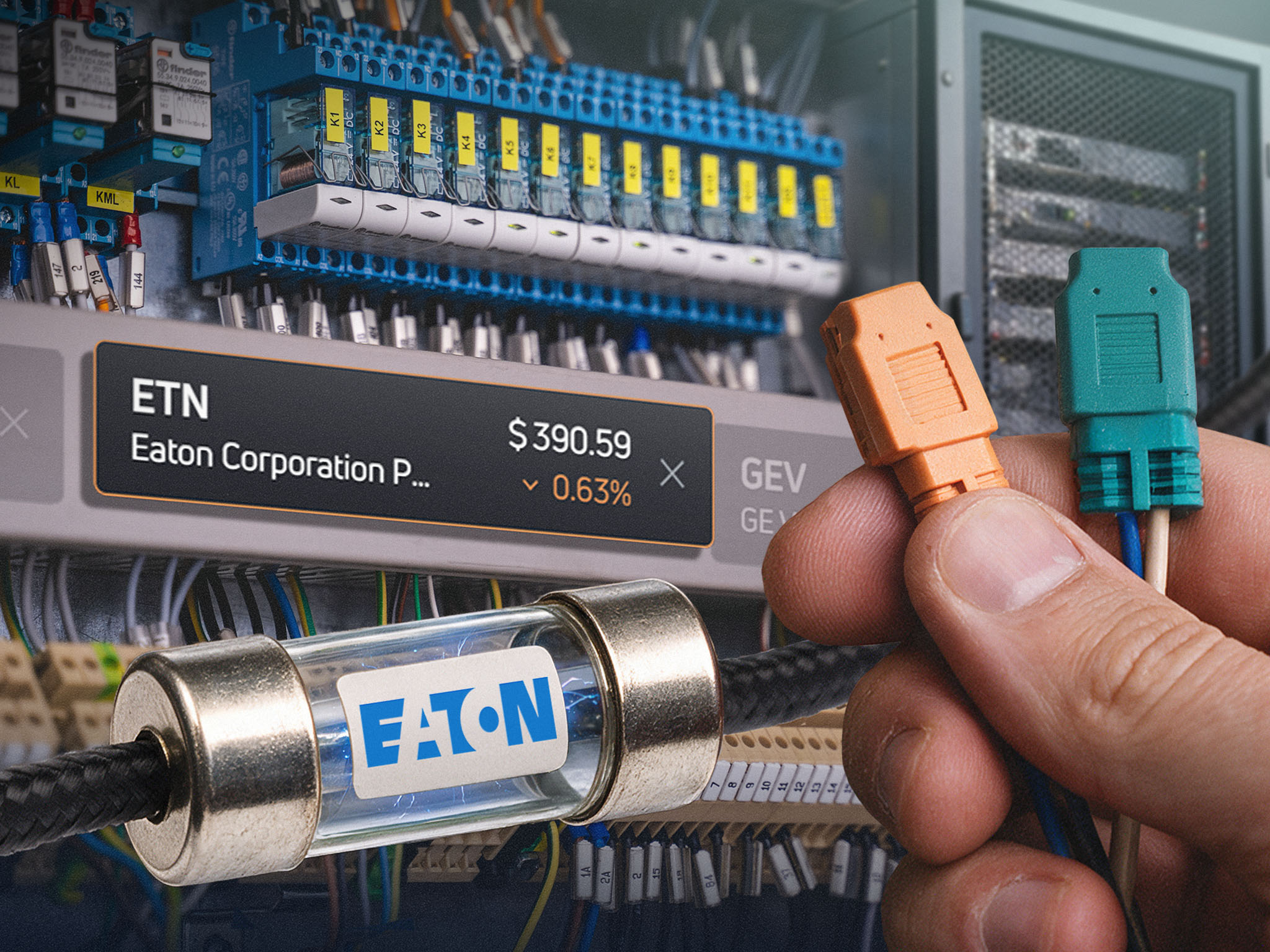


Eaton Corp. (NYSE: ETN) has found its power in the power industry.
It’s one of the world’s top power management companies, providing goods, such as circuit breakers and switchgear, and services, such as microgrid consulting and digital optimization.
The company’s electrical business comprises about 75% of its revenue, selling to data centers, utilities, and commercial and residential buildings. Its industrial business accounts for the remaining revenue, selling to commercial and passenger vehicles and aircraft.
Eaton’s special power comes in making high-quality engineered products that perform “mission-critical functions,” as Morningstar analyst Nicholas Lieb puts it. Often, Eaton’s products are sold in niche portions of industries with a high cost of failure, such as hospitals, planes, and data centers.
Lieb offers a cogent explanation of the business dynamic boosting the company. “When a customer in Eaton’s installed base needs a repair or replacement, or it expands (building a new hospital wing, for example), Eaton is highly likely to win that business,” he says.
“That’s because a slight change in system design can cause a malfunction. System failure can be catastrophic, resulting in huge monetary losses or putting human lives at risk.” So rather than competing on price, Eaton relies on product reliability and customer support.
Solid earnings numbers
The company shined in the second quarter, with organic sales jumping 14% from a year earlier and adjusted profit up 6.3%. Growth in data-center work helped fuel the strong results. The company’s AI orders have skyrocketed 240% over the past year.
“Eaton’s AI infrastructure is indispensable,” Christopher Rossbach, portfolio manager at J. Stern in London, told Barron’s. In addition, second-quarter sales jumped 27% for the company’s electrical unit and rose 13% for its aerospace segment.
Investors have taken note of Eaton’s success, with the stock producing annualized total returns of 19% in the past year and 23% in the last five years, beating the S&P 500.
Lieb thinks Eaton’s electrical and aerospace divisions have the most potential. On the electrical side, Eaton estimates it has a 30% market share of low- and medium-voltage electrical equipment. That’s a market it dominates with heavyweights such as Siemens (CBOE: SIE) and GE Vernova (NYSE: GEV).
Eaton excels with technical know-how, close customer relationships, and product breadth in its electrical unit, Lieb explains. Eaton’s products are present in each step of electricity distribution, starting at the grid and moving to the transformer and switchgear on a customer site, which then distribute power to the end system.
Aerospace flying high
Turning to aerospace, Eaton is heavy in patents and intellectual property. It stands out in aircraft motion controls and fuel and hydraulic pumps, areas with high regulatory barriers and huge costs of failure, Lieb pointed out. It also leads the pack in supplying secondary flight control systems.
And the company enjoys 40% market share of higher-margin aftermarket revenue. “The FAA-mandated servicing of aircraft gives us confidence Eaton’s aftermarket business will flourish,” Lieb said.
Eaton is extremely well entrenched in aerospace. “Often, Eaton has a sole-source supplier advantage on an entire engine family, like its variable bleed valve gear motor on the CFM56,” he said. That’s the most widely sold engine in aviation history.
The company will help satisfy the need to improve infrastructure, which is as old as it has been since World War II, said J. Stern’s Rossbach.
Eaton has produced returns on capital in the low- to mid-teens for decades, and Lieb believes returns will continue topping its cost of capital for the next 20 years.
To be sure, he’s concerned about the company’s hefty debt load. Its debt-to-EBITDA ratio exceeds 3.0. That’s worrisome given the cyclical nature of Eaton’s business. But that hasn’t dampened Lieb’s enthusiasm much.


Comments