


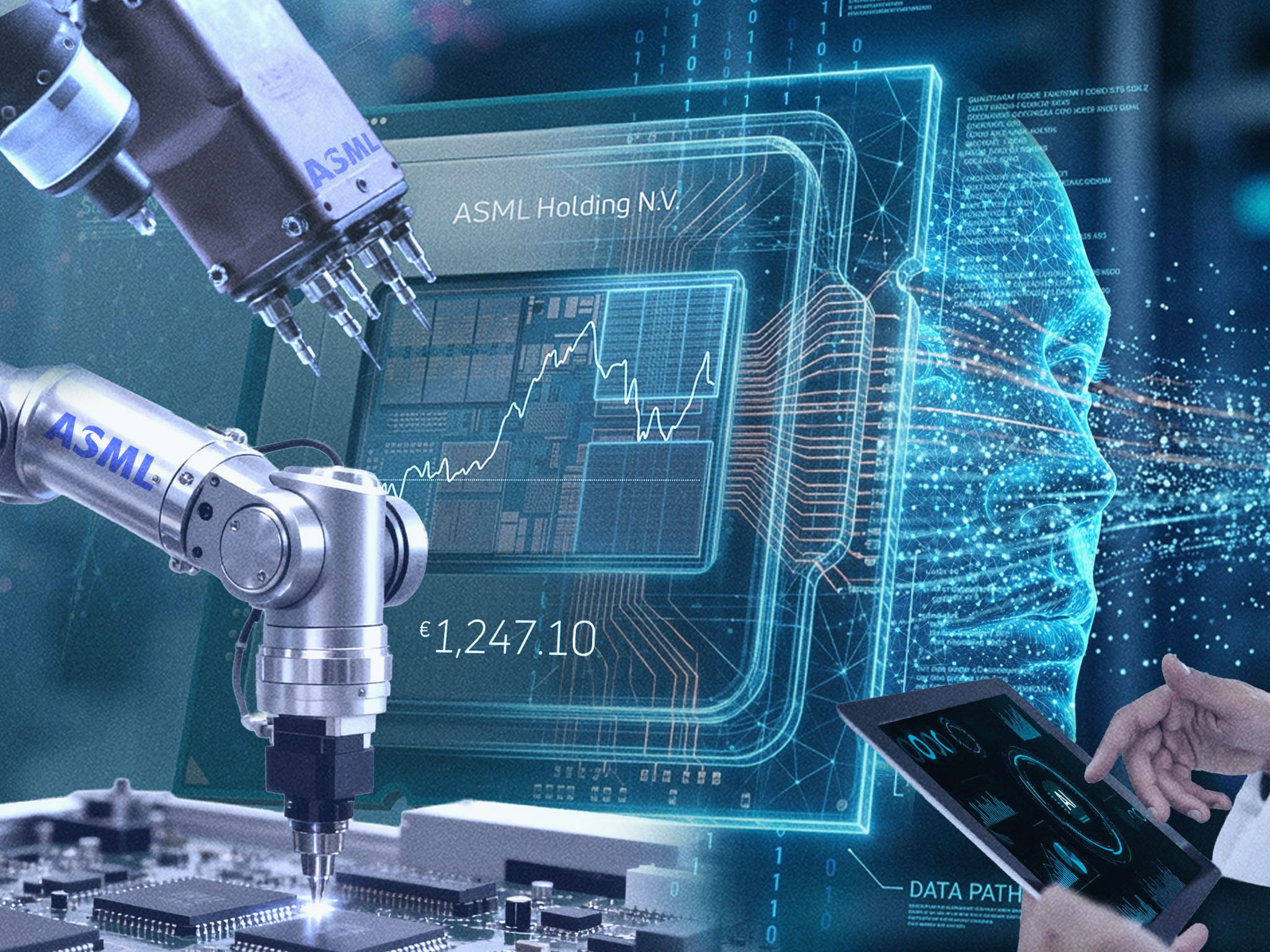


A manufacturer of machinery that makes semiconductor chips, ASML Holding (CBOE: ASML) has found itself at the center of the artificial intelligence boom.
The surge in AI spending has buoyed the Dutch company’s revenue to 8.77 billion euros during the first quarter, an increase from 7.74 billion euros a year earlier. ASML’s net profit rose to 2.76 billion euros from nearly 2.36 billion euros a year prior, exceeding Wall Street estimates.
Management increased guidance due to the higher level of revenue. ASML Holding increased its revenue to 36 billion to 40 billion euros or between $42.47 billion and $47.19 billion for 2026 as more companies are seeking AI chips. The company had previously estimated guidance of 34 billion to 39 billion euros. In 2025, ASML produced revenue of 32.67 billion euros.
The stock rose by 128% during the past year as the spending frenzy to build additional data centers to conduct more AI continues.
ASML’s largest customers, Intel (NASDAQ: INTC), Taiwan Semiconductor Manufacturing Co. (NYSE: TSM) and Samsung Electronics have seen demand skyrocket as companies in many industries have adopted the use of AI in their operations. Their customers want faster and better smartphones, electronic devices and data centers that can churn out data and information.
These semiconductor chip companies have invested billions of dollars into machines such as ASML’s to generate the latest version of AI chips that are faster and more advanced.
ASML is benefitting from its customers seeking the company’s latest production tools.
“The semiconductor industry’s growth outlook continues to solidify, driven by ongoing AI-related infrastructure investments,” said ASML CEO Christophe Fouquet said. “Demand for chips is outpacing supply. In response, our customers are accelerating their capacity expansion plans for 2026 and beyond.”
The volume of orders is high as chip manufacturers are behind on manufacturing the number of semiconductors its customers are seeking.
“We expect in fact that the supply will not meet the demand for the foreseeable future,” he said.
ASML customers continue to invest in machines
The outlook for ASML is “very bullish” and is “no surprise, as demand for advanced logic and memory semiconductors remains very strong, with potential undersupply extending to 2028 or beyond,” wrote Javier Correonero, a senior equity analyst for Morningstar Holland, a wholly owned subsidiary of Morningstar.
ASML’s customers are investing heavily into its machines. South Korean semiconductor company SK Hynix ordered $8 billion in extreme ultraviolet machines in March. SK Hynix provides high-bandwidth memory chips to Nvidia (NASDAQ: NVDA). The purchase is expected to be completed in 2027.
South Korean electronics company Samsung placed an order for 20 EUV machines (about EUR 4 billion-EUR 5 billion), according to an article in SE Daily.
Taiwan Semiconductor Manufacturing Co. is constructing several fabs across Taiwan and the U.S., he added.
“We believe ASML will remain the top lithography equipment provider in semiconductor foundries for the next two decades,” Correonero wrote. “TSMC, Intel, and Samsung redesigned their fabs a decade ago to make them suitable for extreme ultraviolet, or EUV, lithography, a costly and long endeavor, so it is quite unlikely ASML will be displaced from its place in the foundry.”
The company’s technological “leadership” has not been matched by a competitor and this strategic advantage is not likely to be beaten for the next decade, he said.
ASML’s outlook is positive since the company has a competitive advantage, allowing it to expand through its EUR 6 billion research and development budget and customers who need powerful chips to utilize the next generation of AI.


Comments