


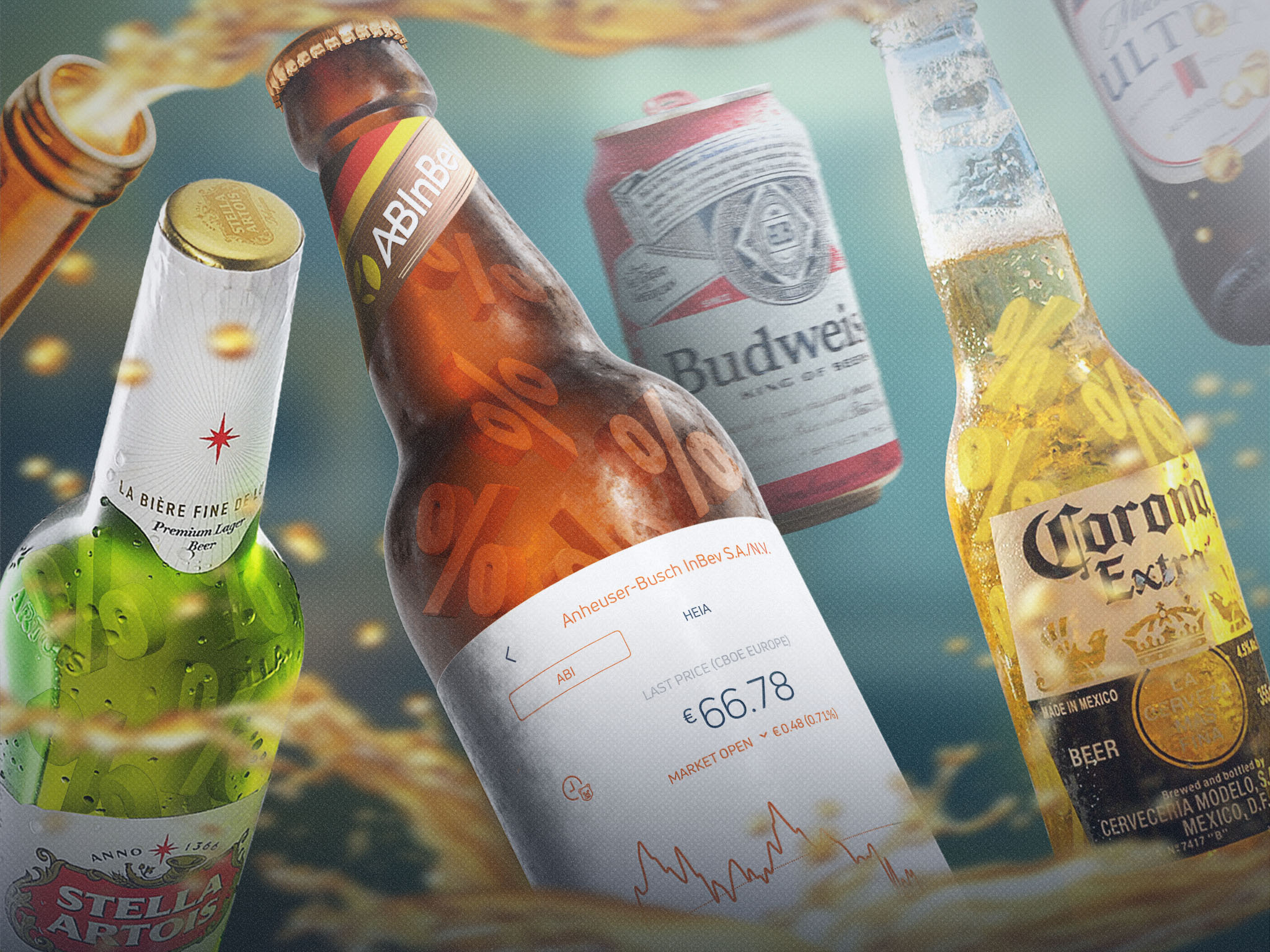


“Nothing beats a Bud” is just an advertising slogan for Budweiser, one of Anheuser-Busch InBev’s (CBOE: ABI) flagship beers. But maybe there is truth in this advertising.
AB InBev is the largest brewer in the world, with more than double the sales volume of its largest competitor, Heineken (CBOE: HEIA). In addition to Budweiser, InBev’s top brands include Michelob (Michelob Ultra is the U.S.’ top-selling beer), Corona (InBev has sales rights outside the U.S.) and Stella Artois.
InBev represents the culmination of numerous mergers, including InterBrew of Belgium and AmBev of Brazil joining in 2004, InBev buying Anheuser-Busch in 2008 and AB InBev purchasing SABMiller in 2016.
InBev’s stock has returned a whopping 54% over the past year, but only 6% annualized over the last five years.
Looking geographically, in 2024, 29% of the company’s revenue came from Middle Americas, which includes Mexico, El Salvador, Honduras, and parts of the Caribbean. Then came North America at 25%, South America at 21%; Europe, the Mideast and Africa at 15% and Asia Pacific at 10%.
Recipe for success
Those numbers translate into success for InBev. “Its monopoly-like positions in several markets [such as Brazil and Argentina], give the firm significant fixed cost leverage and procurement pricing power,” wrote Morningstar analyst Verushka Shetty.
“The firm’s industry-leading margins, excess returns on invested capital, and best-in-class cash conversion reflect this.” Strong cash conversion means InBev generates cash from sales far faster than it pays for its inventory and expenses.
As for profit margins, the company reported a normalized EBITDA margin of 35.8% last year, up 101 basis points from 2024. EBITDA means earnings before interest, taxes, depreciation and amortization.
InBev’s superior position in emerging markets, such as Latin America and Asia, gives it a leg up on competitors, given the strong demand growth expected there in coming years.
About 70% of the company’s EBITDA comes from emerging markets that are projected to account for more than 80% of beer volume growth through 2029, says CEO Michel Doukeris. By contrast, analysts expect demand to decline over the next 20 years in developed markets, as consumers focus more on health.
Premium brands shine
Meanwhile, Shetty says, “InBev is well positioned to capitalize on long-term premiumization trends, where consumers are trading up to foreign from domestic beers.” Its premium holdings include Budweiser, Corona, and Stella Artois. The company’s top brands grew ahead of its overall business last year.
Another strength for InBev is BEES (as in the insect), its B2B e-commerce platform and digital app. BEES is a digital marketplace where customers (retailers) can browse products, place orders, manage invoices, and access data insights.
It’s now used in 20 markets with around 3.1 million monthly active users, the company says. InBev also is building direct-to-consumer applications for home delivery in markets including South America and South Africa. “InBev is ahead of the pack with its digital solutions,” Shetty said.
The company also is enjoying strong expansion in its Beyond Beer and non-alcohol beer lines. Beyond Beer comprises ready-to-drink cocktails, hard seltzers and other alcoholic beverages. The category now accounts for 3% of InBev’s revenue, and the company expects it to grow sales volume at double the rate of its beer segment.
Turning to earnings, InBev’s organic revenue, which excludes currency moves and merger activity, gained 2% in 2025. Total revenue slipped 0.8% due to currency moves. Volume fell 2.3%, meaning the revenue gain came from price increases. Adjusted profit climbed 4.9%.
In any case, the glass is looking more than half full for InBev going forward.
The author owns shares of AB InBev.


Comments