


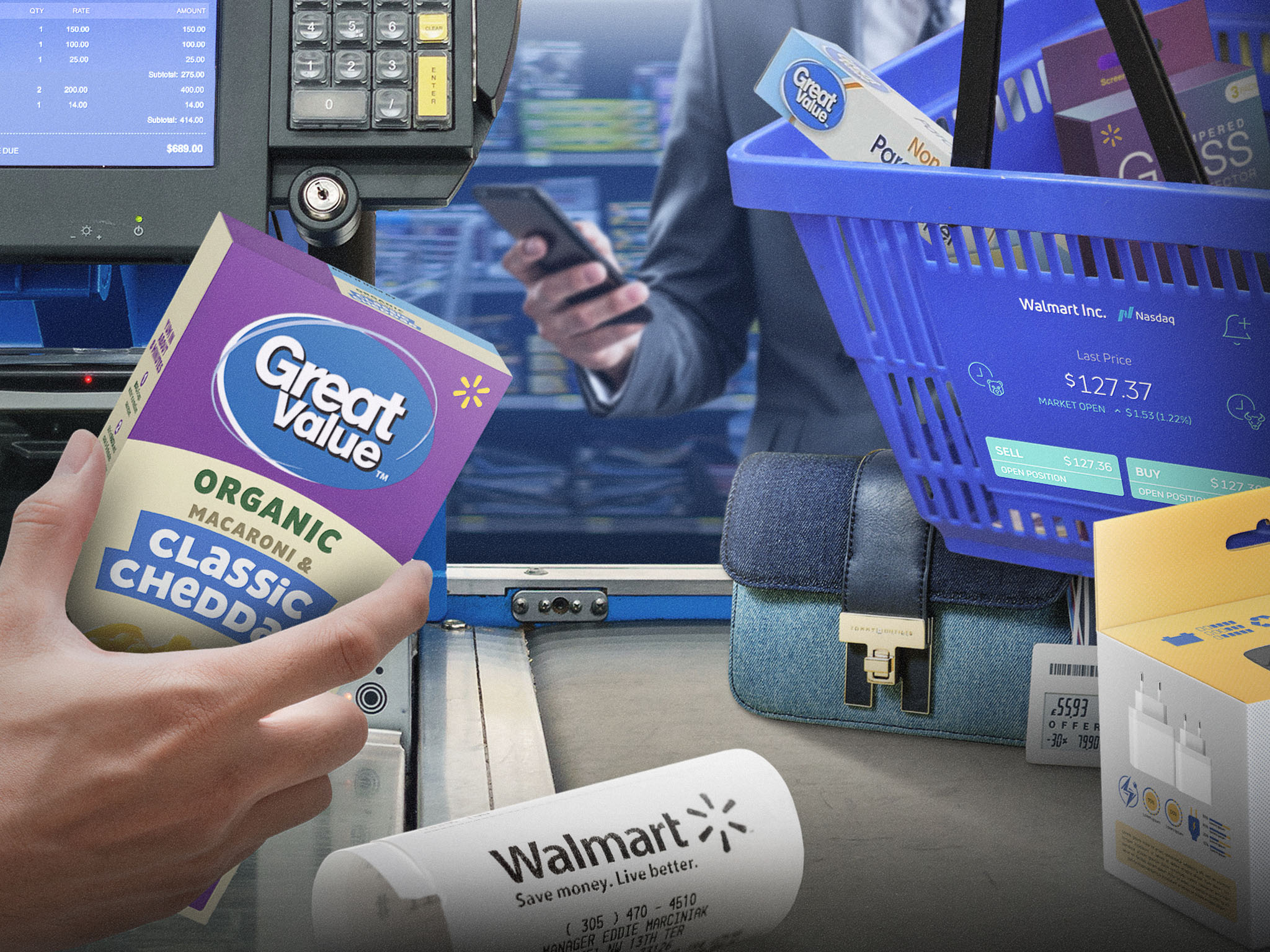


Much has been made in recent days of the fact that Amazon (NASDAQ: AMZN) has surpassed Walmart (NASDAQ: WMT) as the world’s biggest company in terms of revenue.
But that really means very little. If you strip out Amazon’s cloud computing revenue (Amazon Web Services), its pure retail sales are 18% less than Amazon’s. Moreover, returns on Walmart stock have smashed those of Amazon in recent years.
Walmart shares’ annualized total return was 27.5% for the last year and 22.5% for the last five years. That compares to negative 5.7% and positive 5.3% for Amazon. To be sure, Amazon wins over 10 years: 22.9% to 19.7%.
Looking at Walmart, it’s turned from a retailer for mainly lower-income consumers to one that caters to people of all incomes, with a “growing selection of online merchandise that includes everything from pre-owned Prada bags to Fender guitars,” as Bloomberg puts it.
The majority of the company’s share gains in the latest quarter came from households making more than $100,000, it said.
Everyday low prices
Everyone appreciates the chain’s “everyday low prices,” as it calls them, and the convenience of its locations. It has 5,200 stores and clubs in the U.S., and they’re within 10 miles of approximately 90% of the population.
Walmart holds a 67% share of the superstore and warehouse club market – “a dominant position that should hold,” writes Morningstar analyst Brett Husslein. Its warehouse club is Sam’s Club, which charges a membership fee.
Meanwhile, “Walmart’s leading 32% online grocery share and 18% digital penetration underscore the effective conversion of its store scale into digital traction,” he said.
Groceries, which account for 60% of Walmart’s U.S. sales, represent its foundation Husslein maintains. “This category drives frequent visits and supplier leverage, creating a traffic engine monetized through higher-margin categories like general merchandise, health, and private label.”
That one-stop shop phenomenon pushes consumers to consolidate trips to Walmart, boosting wallet share across demographics and preserving its cost edge, Husslein notes. As for private label, Walmart’s own brands, such as Great Value, generate 25%-30% higher gross margins than other brands, despite everyday low pricing.
Revenue heading higher
As for earnings, Walmart’s revenue totaled $190.7 billion in the quarter ended Jan. 31, up 5.6% from a year earlier. Operating income gained 10.8%, though earnings per share slid 18.5%. The gross profit margin gained 10 basis points to 24.7%.
Walmart is making hay in its online operations. Global e-commerce sales soared 24% in the latest quarter from a year earlier. That was led by store-fulfilled pickup and delivery and Walmart Marketplace, which houses third-party sellers. “The firm’s high-margin digital revenue streams are rapidly altering the profit algorithm,” Husslein said.
Another strong element of the company is Walmart+, a paid subscription service that offers members free shipping, including same-day delivery of groceries; free video streaming services; fuel discounts; and more. It’s estimated to have about 30 million members.
Walmart’s global advertising business, which consists of net sales or reduction to cost of sales depending on the deal, soared 37% in the latest quarter from a year earlier. In the U.S., its ad business (Walmart Connect) was up 41%.
“Together, Walmart+ and Walmart Connect generate over $5.4 billion in revenue at 70%-80% operating margins,” Husslein said. “We believe these areas will represent a growing share of profit, compounding at high-single-digit rates.”
So Walmart appears to be firing on all cylinders.
The author owns shares of Walmart.


Comments