


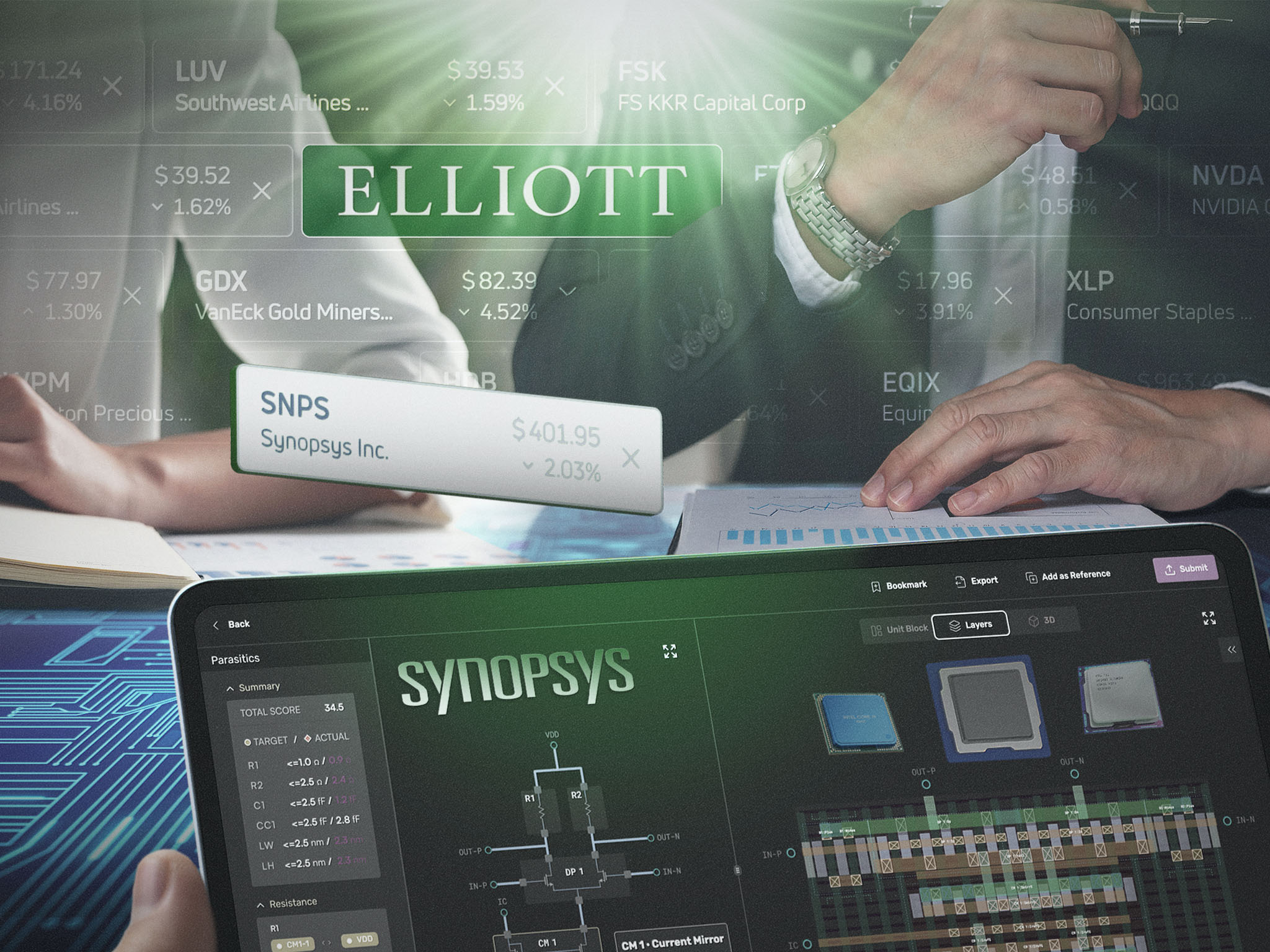


Chip design software company Synopsys (NASDAQ: SNPS) should increase its prices in an effort to raise its margins, a strategy pushed by activist investor Elliott Investment Management who purchased a large stake in the company.
Synopsys has pricing power and is currently not using it to increase its profit margins. Elliott has a multibillion-dollar investment in the $83.7 billion market cap company that saw its shares rise by 4% after the news was reported by the Wall Street Journal.
Elliott Managing Partner Jesse Cohn said Synopsys, which designs complex semiconductor chips, is “essential” to the chip industry.
“As AI drives a step change in chip complexity and capital investment, Synopsys is uniquely positioned to benefit from this growth,” he told the WSJ.
Synopsys, along with its main competitor, Cadence Design Systems (NASDAQ: CNDS), which has a market cap of $81.4 billion, produces software that is essential for companies such as Nvidia (NASDAQ: NVDA) because they create and design the chips they need as the use of artificial intelligence surges.
While Nvidia has raised its prices recently on its more advanced graphics processing unit known as GPUs, Synopsys needs to increase its revenue and margins to have more similar results, such as Cadence, sources familiar with the matter told the WSJ.
Synopsys is undervalued partly because its margins are too low – the company reported gross margins of 70% to 75% compared to Cadence, which generated gross margins of 85% to 90%, according to CNBC.
In addition, Cadence’s operating margin is 30% compared to Synopsys, which produced an operating margin of 15% to 25%. The lower margins have resulted in lower net profit margins of 18% to 23% for Synopsys compared to Cadence, whose margin is higher at 20% to 25%.
Shares of Synopsys have also been underperforming, falling 4.8% during the past year, while investors appeared to have chosen Cadence, whose stock rose by 10.6% during the past year.
Elliott’s strategy
Elliott said it seeks to work with Synopsys to not only generate more cash flow from selling its software, but also its services sector, people familiar with the matter told the WSJ.
There is a “clear opportunity for Synopsys’ financial performance to more fully reflect the value it delivers,” said Cohn.
The activist investor plans “to help align operational execution, profitability, and monetization with its potential and importance to the semiconductor ecosystem,” he added.
The semiconductor industry is a current focus for Elliott, which manages $80 billion in assets and invested $1 billion in social media firm Pinterest (NYSE: PINS) in March, boosting shares by 7.8% during the past month. Elliott, led by founder Paul Singer, also has acquired stakes in Sandisk (NASDAQ: SNDK), which provides memory storage products, and Western Digital (NASDAQ: WDC), a manufacturer of high-capacity hard disk drives. Both stocks emerged as the two top-performing stocks in the S&P 500 index in 2025.
Elliott’s record has been mixed. Since 2015, the hedge fund has started 131 activist campaigns, according to a 2022 Barron’s article. Investors do not always see better returns for their shares. The average return is 4.9% of the 76 activist stock positions taken since 2018, much lower than the S&P 500’s average of 6.6 percentage points, the article said.
The hedge fund also bought $2 billion worth of shares in payment company PayPal (NASDAQ: PYPL) in 2022, which gave it an initial boost of 12% in its stock. But in 2023, Elliott dissolved its stake. Over the past year, PayPal’s shares have fallen by 36%.
The management team of Synopsys has said its industry remains “under-monetized,” according to Citigroup research analysts in a March report.
Synopsys has major Fortune 500 customers, including Nvidia, which spent $2 billion buying shares of the company late in 2025. Nvidia CEO Jensen Huang said the current surge in building out infrastructure to increase AI will benefit the company at an industry event.
“The number of Synopsys’ tool users [is] gonna go through the roof,” he said.
Alphabet (NASDAQ: GOOG), Intel (NASDAQ: INTC), and Tesla (NASDAQ: TSLA) are some of the company’s other customers.
Revenue for Synopsys rose to $2.409 billion during the first quarter of fiscal year 2025, an increase of 65% from compared to $1.455 billion for the same period a year ago, which is at the high-end level of the company’s previous guidance. The company’s net income fell to $65 million, compared to $295.7 million.
In 2025, Synopsys closed its deal to acquire Ansys for $35 billion. The company estimates full-year total revenue of $9.61 billion at the midpoint, which includes $2.9 billion of Ansys revenue. Buying Anysys will help broaden the company’s ability to sell its software for additional industries as designing chips becomes more complicated.
Investors might be wary and are waiting for more certainty around the intellectual property business, which sells predesigned chip components, wrote Eric Compton, director of equity research, technology, for Morningstar.
“We think much of the hesitation on Synopsys currently revolves around uncertainty for the IP business, along with general worries for software companies in an AI world,” he said. “For IP, management reiterated that it expects traction with new projects and new pricing structures starting in the fourth quarter.”
But the growth in AI is a “tailwind” for companies such as Synopsys since the higher demand will result in more “demand for new, complex chip designs, and will give Synopsys new pricing vectors as AI tools add more value for end clients, Compton wrote.
Elliott’s stake in Synopsys might be the impetus that management needs to increase its profits and shareholder value.


Comments