




When you hear about intrusive critters such as rats, cockroaches, ants, bedbugs and termites, your first thought may be: “gross!”
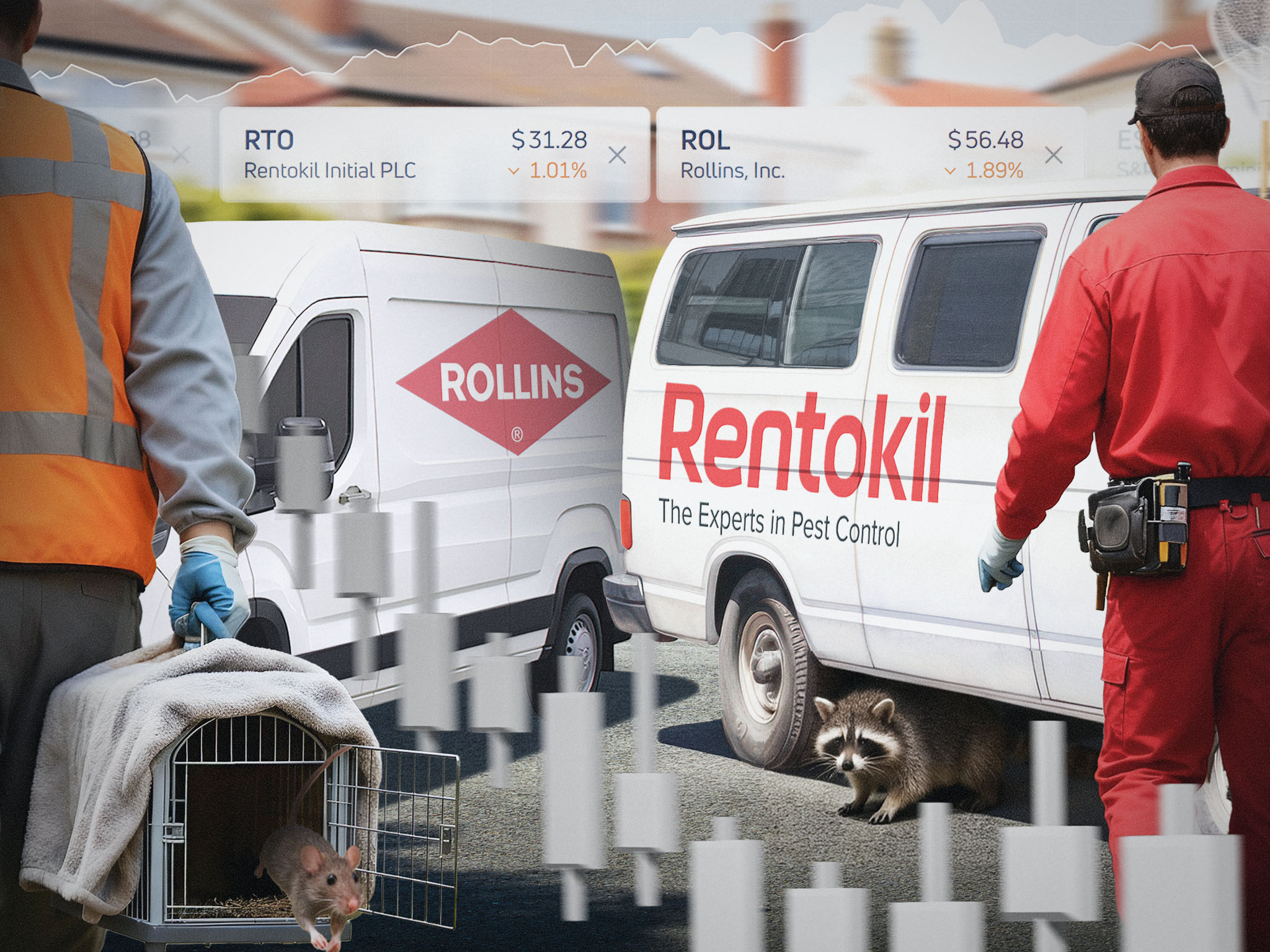
But for the two leading pest control companies, Rentokil Initial (NYSE: RTO) and Rollins (NYSE: ROL), those disgusting varmints mean money. The former has a market share of 30% in the U.S., and the latter has a 24% share. The rest of the market is fractured among small players.
The two companies’ size gives them a cost advantage. That’s because they have dense local routes, allowing them to spread costs across a larger revenue base thus boosting profit margins.
Demand for pest control is largely constant, of course. Who wants to see rats scurrying across their bedroom or office or a restaurant’s kitchen? Several trends also are boosting the industry, including consumers’ increasing health concerns, rising global temperatures that extend pest seasons, urbanization, and a preference for extermination services over do-it-yourself, notes Morningstar analyst Ben Slupecki.
Both Rentokil and Rollins grow through bolt-on acquisitions, with the former making 40-50 per year and the latter making 30-40. Those purchases allow the companies to increase route density in their regional markets, Slupecki points out. While most costs are fixed, they are primarily incurred locally.
By creating regional scales, the companies can add a new customer to an existing route without incurring additional fixed costs. “This is imperative to [the companies’] strategy and continued margin expansion,” Slupecki said.
Rollins has outperformed Rentokil in profit margins over the last 15 years, with the former scoring a 7 percentage-point increase in its operating margin, compared to 2 points for the latter.
Rollins has benefited from its Branch Operating Support System (BOSS). This technology platform acts as a central nervous system for Rollins’ branch offices, designed to improve service efficiency, reduce costs, and enhance customer experience.
Meanwhile, Rentokil suffered from poor integration of Terminix, which it bought in 2022 for $6.7 billion. For example, the two still have separate back-office operating systems for many of their North American branches.
Rollins also has more U.S. brand awareness with Orkin than Rentokil has with Terminix. Half of Orkin’s new customers don’t consider a competitor when purchasing, according to Slupecki. But Rentokil doesn’t match that, as evidenced by its sales struggles after the Terminix acquisition, he said.
Rollins’ stock has generated an annualized total return of 19.4% over the past three years, compared to just 2.9% for Rentokil. But the latter is coming back strong. It returned 43.3% in the last 12 months, far ahead of Rollins’ 14.07% return.
Rentokil posted a 2.6% increase in organic growth during 2025. Adjusted operating profit climbed 5.4%, thanks to North American cost efficiency initiatives. “A more streamlined data process makes it easier for employers to access customer data, which, combined with satellite branches, has improved lead generation,” Slupecki said.
Rollins’ organic revenue climbed 6.9% last year, and adjusted operating income rose 11.4%.
Both companies have a bright future, Slupecki said. “While Rollins is well positioned to deliver medium-term revenue growth, the market overestimates its chances of becoming the sole dominant player in the pest control industry,” he said. “We expect Rentokil to regain momentum and reassert its competitive position.”
So the business of pest extermination has life.
The author owns shares of Rentokil.


Comments