


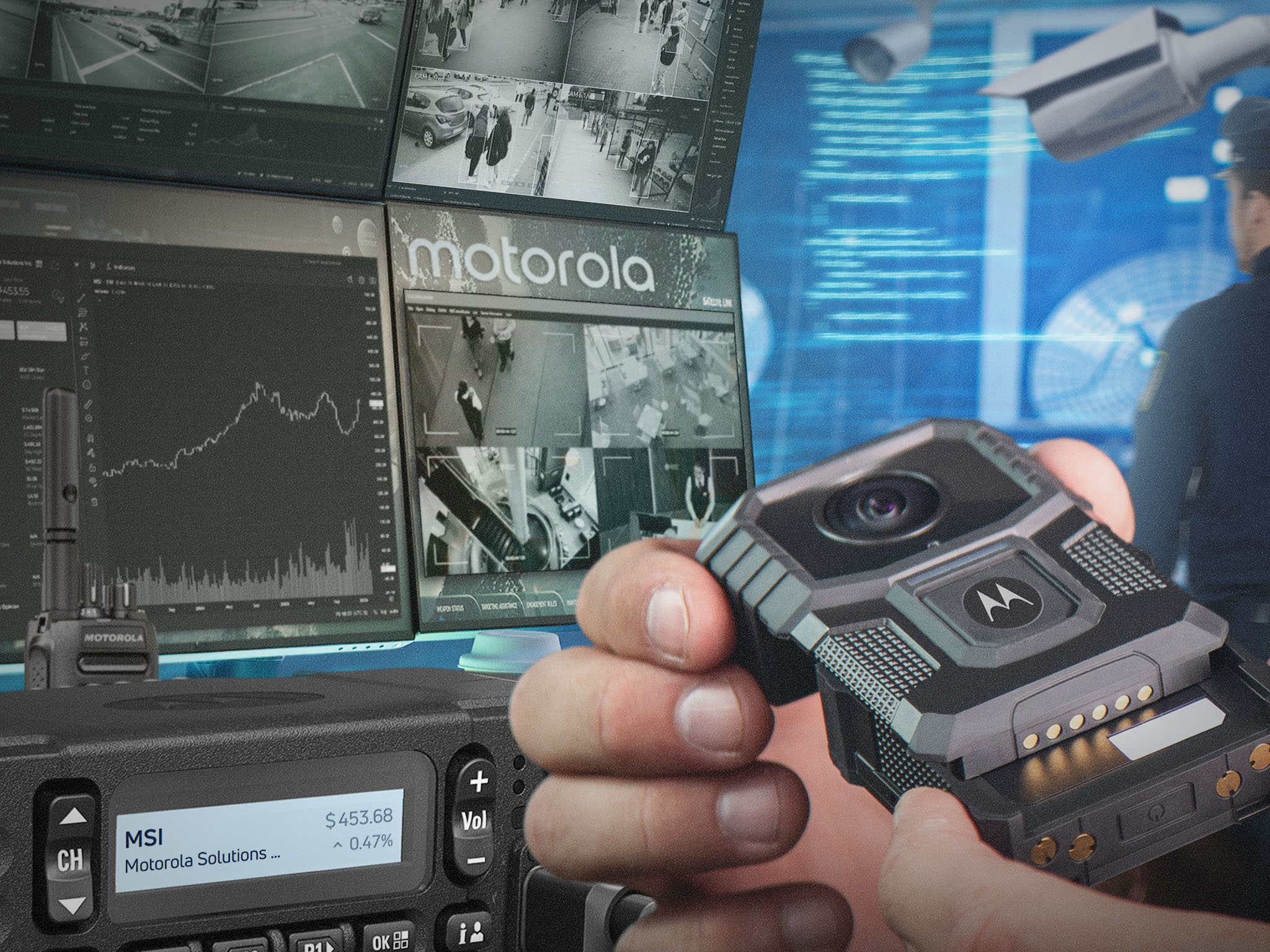


Known for its durable two-way radio systems used by first responders and law enforcement, Motorola Solutions (NYSE: MSI) grew its revenue by double digits during the fourth quarter, driven by higher demand for its products.
The communications tech company also plans to launch additional products in 2026, including ones with artificial intelligence to attract more customers.
The company reported sales of $3.4 billion, a 12% increase from the previous year and 8% for 2025. Both of its divisions also reported double-digit growth. Revenue in its products and systems integration grew by 11% during the quarter and 5% for the full year, while sales for its software and services unit increased by 15% during the quarter and 13% for 2025.
Motorola Solutions also reported a record ending backlog of $15.7 billion, up $1 billion compared to the previous year.
The company’s orders grew by a whopping 26% as demand remained “strong,” generating $1.3 billion of operating cash flow during the quarter, an increase of 19% for 2025 and record free cash flow of $2.6 billion, up 21% versus the prior year, CEO Gregory Brown said during an earnings call. The strong growth in orders during the fourth quarter is the third consecutive quarter of double-digit product orders, he added.
“We expect double-digit product orders in Q1, and we expect double-digit product orders for the full year in 2026,” Brown said.
The safety and security company, which sells equipment and software to police and fire departments, utilities, and schools, such as walkie-talkies, has seen higher growth due to generating revenue from its video security and software business and the adoption of AI capabilities in its products.
Expanding its business to the sports industry, even selling products for the popular World Cup, an international soccer tournament that occurs every four years, generated a new deal from the Vancouver, Canada area of “network refresh, a refresh of fixed video opportunities,” said COO John Molloy during an earnings call.
Shares of the stock rose by 18% year-to-date with a 15% gain in the past month.
Diversification of business units through deals
Back in 2011, Motorola split into two companies: Motorola Mobility, which sold smartphones and is now owned by Lenovo, and Motorola Solutions, which sells radio and video equipment and private communications networks.
The recent acquisition spree of Motorola Solutions has proven to be profitable, adding $188 million in revenue during the fourth quarter. In 2025, the company closed four acquisitions for $4.9 billion, including its purchase of Silvus Technologies Holding, a mobile ad-hoc networks company, for $4.4 billion, and closed the acquisition of Blue Eye, a provider of AI-powered enterprise remote video monitoring services, for $79 million.
The acquisition of Silvus Technologies added the “rapidly growing new defense and unmanned systems market” to the company’s portfolio of products, Brown said during its earnings call. “In addition, we strengthened our portfolio in cloud-native 911 solutions, AI-driven workflows, and remote video monitoring,” he added.
Motorola Solutions “offers one of the most comprehensive solution sets for public safety, a sticky business where it is a major player,” wrote Eric Compton, director of equity research, technology, for Morningstar. “We expect consistent growth and margin expansion, with potential upside if the firm can complete additional accretive acquisitions.”
The company still generates 75% of its revenue from public safety and defense, such as police and fire departments, critical infrastructure, and public services, while the remaining 25% comes from utility companies, hospitals, schools, manufacturing facilities, retail and hospitality, and stadiums.
One advantage that Motorola maintains is its networks, which are durable during weather disasters such as flooding, hurricanes, and wildfires when communication from cell towers can falter or fail. The company made its mark in history when it first developed a two-way radio system in 1939, its equipment communicated the first words from the moon in 1969, and developed the first commercial handheld cellular phone and system in 1983.
Higher demand for video, security
As schools, hospitals, and other entities seek greater security, Motorola’s video security and access control division, which is powered by AI, grew its revenue to $2.1 billion in 2025.
The company reported that “nearly half of revenue [is] now video, software, unmanned systems and recurring services” with revenue from cloud, AI, and software as a service “growing rapidly,” according to its February investor presentation.
Motorola is also producing more revenue and profit from “increased demand for drones and unmanned systems driving growth in defense verticals,” which generates “durable cash flows driven by recurring and recurring revenue,” the company said.
Adoption of AI in products
The growing use of AI has resulted in Motorola creating more efficient products, such as its SVX product, “that converges secure voice, video, and AI and eliminates the need for a separate body-worn camera”, the company said.”
When AI is combined with cameras and footage, the “video solutions combine computer vision with AI, helping to recognize what’s important and what’s not,” Motorola said.
Motorola plans to “make significant investments in AI,” Brown said. In January, the company launched its first two public safety AI assist suites for 911 dispatchers and first responders.
Additional growth and margin expansion are expected from Motorola, especially if “additional accretive acquisitions” are conducted, Compton said.Motorola is likely to increase its share in 911 dispatch centers for emergencies and generate more sales for its video equipment and software unit from public safety agencies and commercial enterprises, boosting its profit margin.


Comments