




Mergers between large companies often don’t work too well in terms of business and share-price performance.
That’s particularly true in the consumer packaged-goods industry. Of 45 major deals in that sector since 2000, about 50% ended in hefty impairment losses, and the five biggest deals failed to deliver on promises, according to BNP Paribas analysts, as cited in The Wall Street Journal.
In the food industry, the Kraft Heinz combination of 2015 is a poster-child for merger meltdowns.
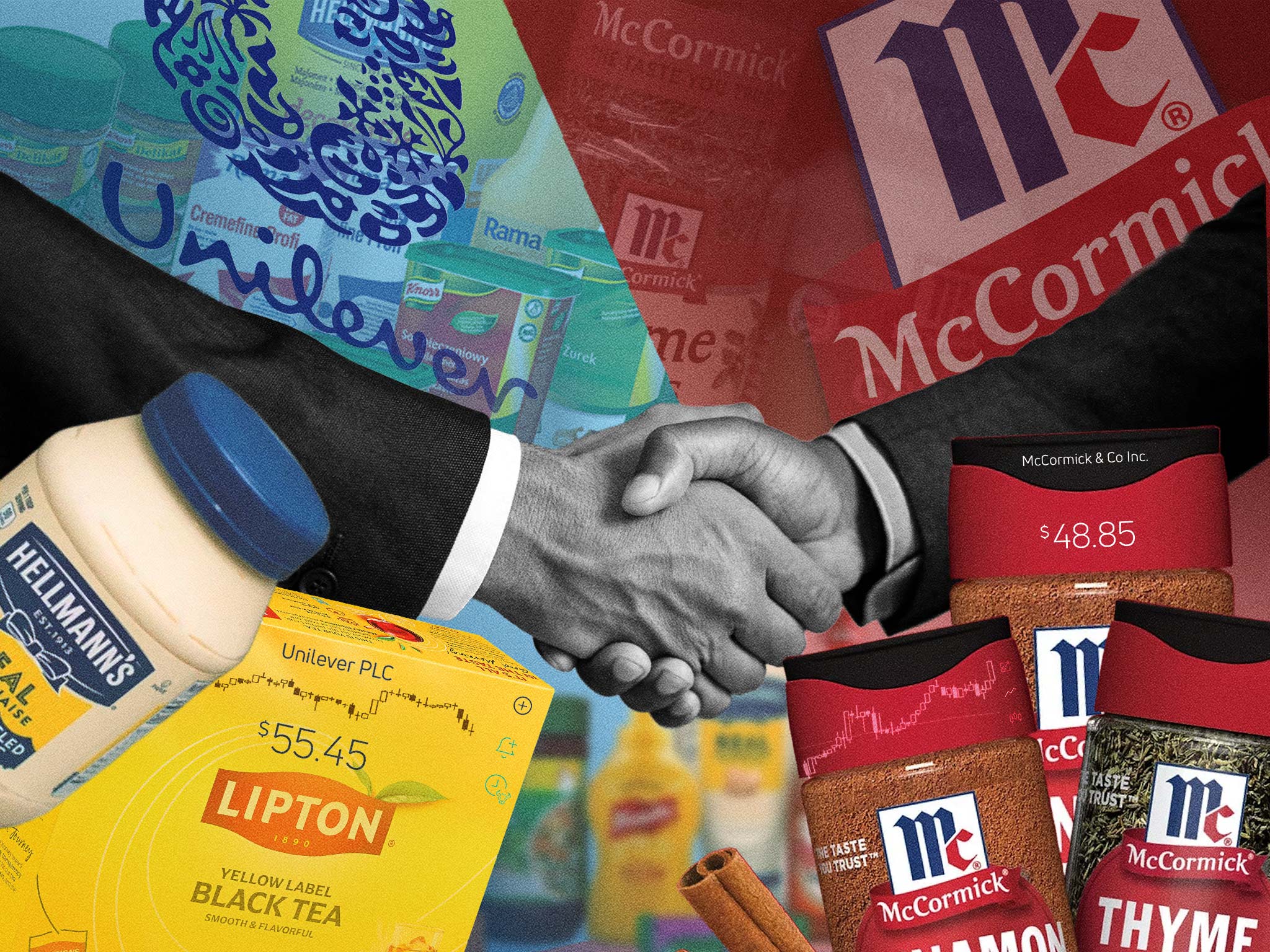
And now, investors are giving a big thumbs-down to spice giant McCormick’s (NYSE: MKC) $45 billion purchase of Unilever’s (NYSE: UL) food business, announced March 31.
Unilever and its shareholders get 65% ownership of the combined company. Unilever’s food brands include Hellmann’s, the world’s biggest seller of mayonnaise, and Knorr’s, famous for its bouillon cubes. McCormick becomes a sauces-to-spices colossus.
Since March 30, the day before the transaction was announced, Unilever stock has dropped 7.4% and McCormick has lost 10.1%. So why does everyone seem to hate this deal?
Integration risk in merger
First, there’s integration risk. McCormick has handled bolt-on (smaller) acquisitions well in the past. That includes its $800 million purchase of Cholula hot sauce in 2020. But the Unilever deal is a whole new kettle of fish. The combination will double McCormick’s annual sales to more than $20 billion. Growth of that magnitude obviously brings complications with it.
“Integration risk is high,” notes Morningstar analyst Erin Lash. She thinks management can reach its goal of $600 million in savings from the merger in three years, but that some of the savings will be reinvested in product innovation and marketing.
“Despite the combination’s strategic merits (enhanced scale and distribution reach in condiments and cooking aids through Knorr and Hellmann’s), we think this may be a ploy to incite growth in an industry where gains have stagnated,” she said. Lash cut her fair value estimate for McCormick stock to $65 from $68 after the merger was announced. It traded at $49 Thursday.
For Unilever, shedding its food business represents a decision to focus solely on personal-care and home products. That business is poised for higher future growth than Unilever’s food business, but at the cost of lower profit margins, writes Morningstar analyst Diana Radu. The food business had an adjusted operating margin of 23% in 2025, compared to 19% for the rest of the company.
Unilever turns pure-play
“While Unilever’s ambition to become a pure-play home and personal care company with more focused execution makes sense strategically, these categories are more fragmented and competitive than food, where Unilever has clear market leadership,” she said.
James Edwardes Jones, an analyst at RBC Capital Markets, says Unilever didn’t get a good deal in the merger. “What we really can’t get our heads round is why is Unilever disposing of a business dominated by two brands, of which it owned 100%, for a minimal control premium,” he wrote in a commentary cited by Barron’s.
And he doesn’t see the rationale for Unilever to leave its shareholders with a 55% stake (Unilever itself keeps a 10% stake) in a “sprawling” food business.
Advocates of mergers like to call them win-win (a victory for each company), but investors seem to view this one as lose-lose.

Comments