


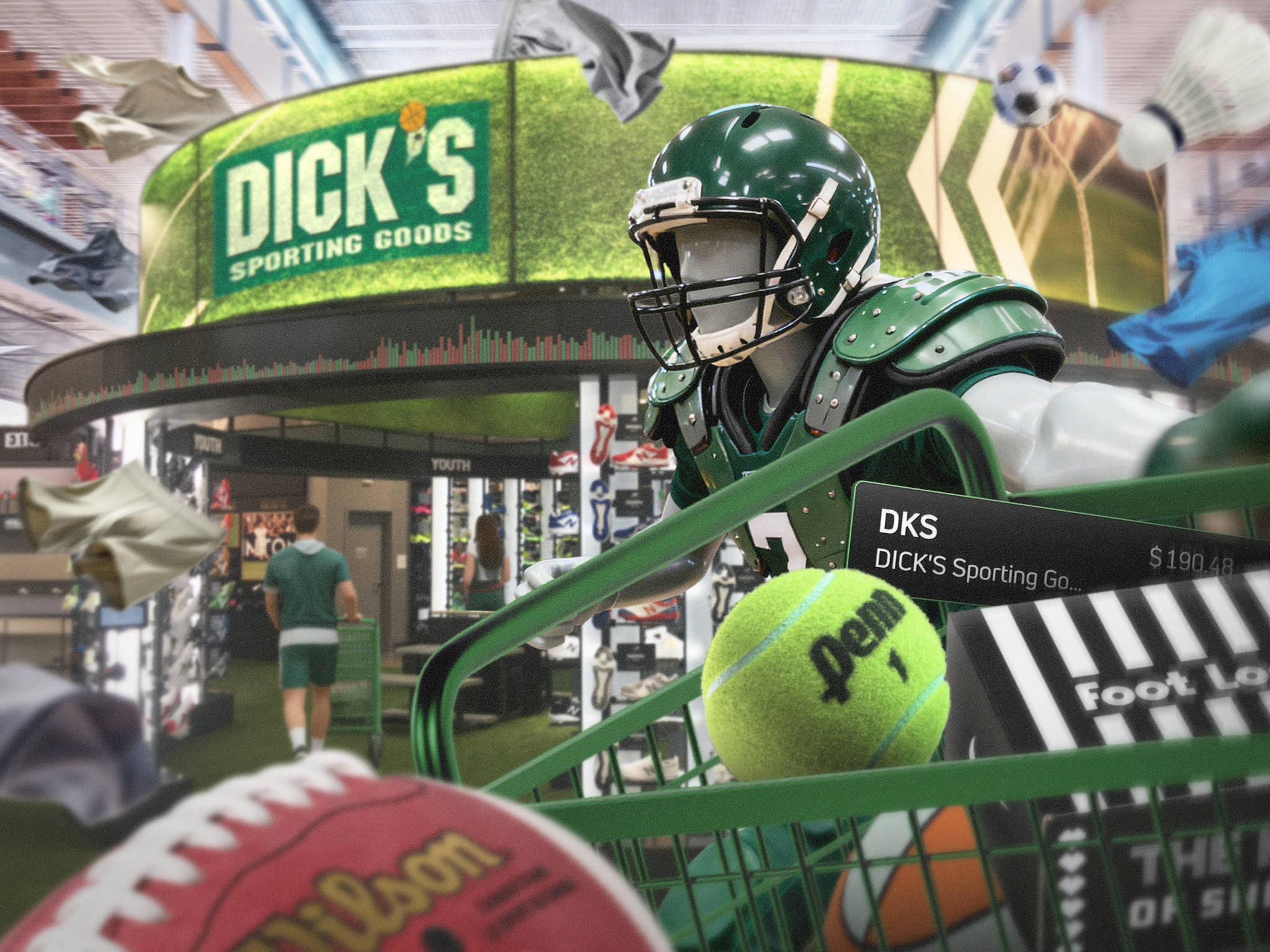


The retail sporting goods industry has shrunk to one major national player: Dick’s Sporting Goods (NYSE: DKS).
Dick’s and athletic-shoe retailer Foot Locker accounted for 25% of the U.S. retail sporting goods market in 2024, according to Euromonitor. Dick’s bought Foot Locker last year for $2.4 billion. Foot Locker has about 2,560 stores and the rest of Dick’s has about 890.
The company has a sharp business model and solid execution, analysts agree. One element of the model that particularly impresses them is Dick’s 35 “Houses of Sports”. These super stores span 120,000-150,000 feet, compared to 50,000 for a regular Dick’s.
They have baseball batting cages, climbing walls, golf simulators, outdoor fields and ice rinks. The experiential format is working. Each House of Sport store enjoyed five to six times more traffic than Dick’s normal stores from early 2023 to July 2024, according to Placer.ai. Dick’s said the stores provide 25% cash-on-cash returns, a measure of pre-tax cash income divided by cash invested.
The company plans to have up to 100 Houses of Sport by the end of next year. And it’s adding many House of Sport enhancements to its existing and new stores. That “has propelled better product assortment and solidified supplier confidence in its ability to engage consumers effectively in the future,” wrote Morningstar analyst David Swartz.
Loyalty program, killer app
Another strength of Dick’s is its loyalty program. It boasts 25 million ScoreCard members, who generate 50% of the company’s sales. That includes 8 million ScoreCard Gold members – high-value customers who spend more than $500 annually.
“Dick’s loyalty program provides valuable insights into the behavior of its top customers, ensuring optimal product availability and more efficient marketing, which is further supported by a dataset of over 160 million athletes,” Swartz said. Dick’s also monitors “dwell time” – the amount of time people spend in its stores and on its apps.
Speaking of apps, Dick’s has a popular one called Game Changer that allows users to watch games, view statistics and share video highlights. The app is particularly popular with the youth sports market and has 9 million users, producing almost $150 million of annual revenue.
Despite all of Dick’s strengths, fully integrating Foot Locker will be a tough task. Foot Locker has suffered from overstocking inventory, which led to price discounts, and from inflation, which led some consumers to cut back on their purchases. Foot Locker endured a 3.3% drop in proforma comparable sales in the year ended Jan. 31.
Turning around Foot Locker
But many analysts think Dick’s can turn Foot Locker around. “Although Foot Locker has been in decline, we anticipate Dick’s management will bring more consistent results, and cost benefits of at least $100 million per year will be achieved,” Swartz said.
Dick’s is having Foot Locker dump old inventory (including elimination of 30% of styles), introduce new merchandise, modernize stores, and close some underperforming locations.
Dick’s, excluding Foot Locker, delivered a 4.5% comparable sales increase in the year ended Jan. 31. Thanks to Foot Locker, the combined company suffered declines in adjusted operating profit margin and earnings per share in the latest quarter from a year earlier. The profit margin fell to 7% from 10.1% and EPS slid to $3.45 from $3.62.
The company’s stock posted a 23% annualized return over the past five years, but just 5.6% over the past 12 months amid Foot Locker’s woes.
Still, Swartz expects a return to double-digit operating margins for the whole company within five years. “Dick’s can achieve 2%-3% comparable sales growth in its core business, while early returns on upgraded Foot Locker stores suggest that even chronic underperformers can be turned around,” he said.
So Dick’s may continue to reign supreme in the sporting goods world.


Comments