


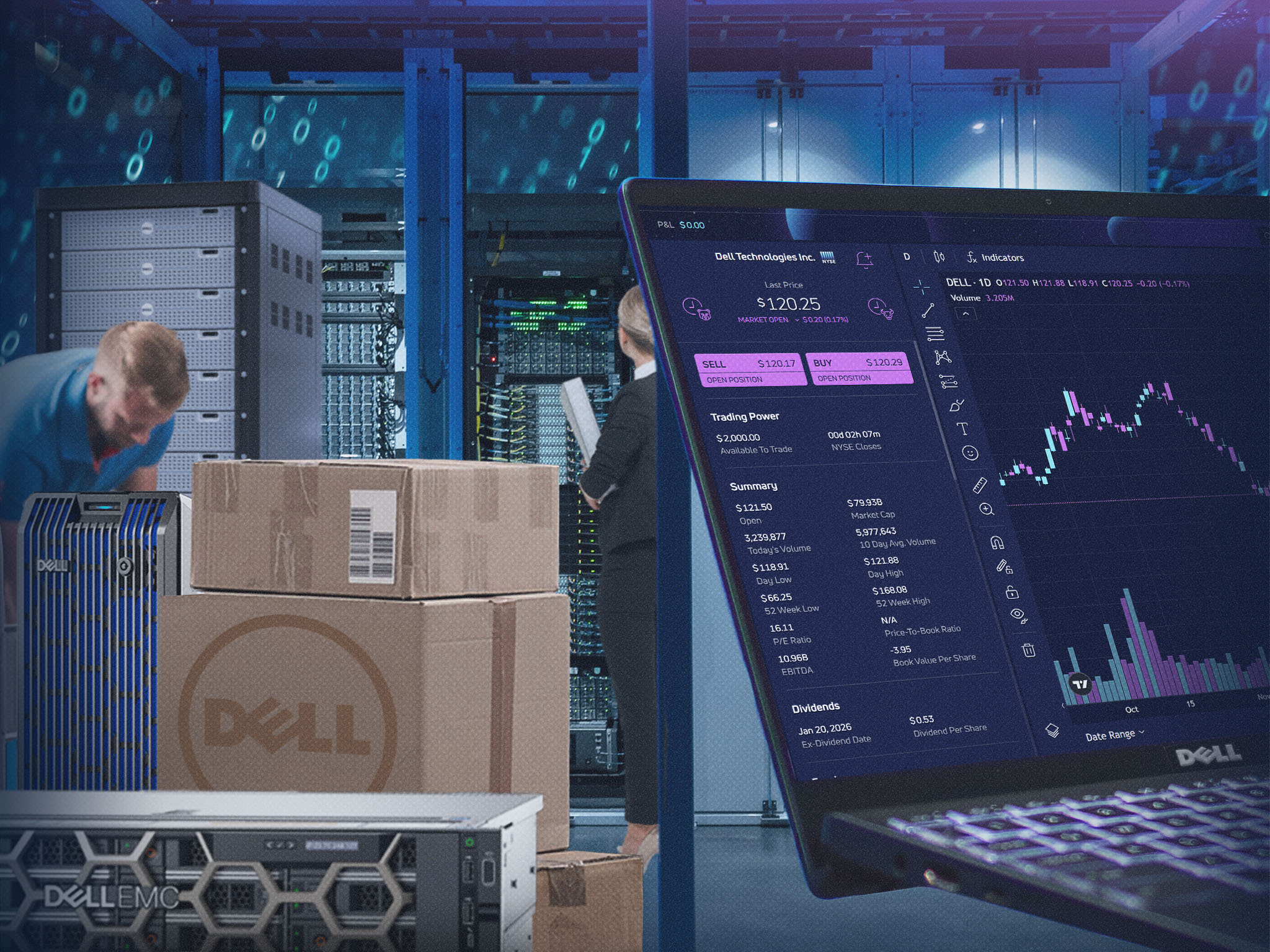


As the demand to build out infrastructure for artificial intelligence increases, Dell Technologies (NYSE: DELL) is reaping the rewards.
Over 50% of the company’s revenue stems from selling its storage and servers to corporations that need the hardware, as more companies are adopting the use of AI to increase the efficiency of their operations.
AI servers are in high demand
Servers for AI remain relatively new, and as corporate sales rise, Dell’s revenue and profit margins are also likely to see a shift in growth.
Dell can also benefit from service revenue, which often generates higher margins as well as selling businesses more memory, networking, and storage upgrades.
“Servers and storage are less consolidated, but Dell is a leading player in both segments,” wrote Eric Compton and Jivyaa Vaidya of Morningstar. “AI servers are an exception, with much faster growth. Fundamentally, much of the manufacturing is outsourced, and products among competitors are similar enough that it is hard to generate pricing power. Dell’s strategy for addressing these limitations is to operate as efficiently as possible, particularly by effectively managing its working capital base. Artificial intelligence-optimized servers are the latest emerging growth driver for OEMs like Dell.”
The company also generates revenue from its infrastructure solutions group, which reported a 44% growth in sales year over year to $16.8 billion during the second quarter. The servers and networking subsegment reported an increase of 69% due to more demand for AI servers.
Dell expects to generate over $20 billion in sales from AI servers in fiscal 2026, up from its previous estimate of $15 billion.
Servers produce a healthy percentage of sales – Grand View Research estimates the business to increase by 39% each year to produce $854 billion by 2030. Companies are shelling out over $100 billion annually on these servers.
Reviving the XPS brand, focus on the consumer again
Dell has spent part of the past decade or more either as a private company or shifting its focus to servers, storage, cybersecurity, and away from its original core products like the personal computers and laptops that were used by numerous Fortune 500 companies.
Back in 2013, founder Michael Dell took the company private along with the financial backing of private equity firm Silver Lake Partners, but went public again five years later.
Nearly a decade ago, in September 2016, Dell closed its $67 billion deal to acquire EMC to focus on data centers and the cloud.
The stock hasn’t been performing poorly – its five-year return is 208%. But in the past year, it only rose by 5%, and during the past six months, it lost most of its gain by declining by 4.6%.
Now, Dell’s Chief Operating Officer, Jeff Clarke said the company needs to pivot back to its original strategy of selling personal computers and away from its more expensive options that are sold to its commercial customers.
The company, which once focused on selling hardware, saw its customers switch their purchases to their competitors.
Clarke’s focus is on selling computers to a larger range of customers, a nod to the loss made by the PC business last year. Four months ago, he was put in charge of the PC business and acknowledged that the company’s focus shifted.
“We’ve got a bit off course,” he said, according to a Wall Street Journal article.
Dell named Rob Bruckner, who began working for Dell back in December, as the head of the commercial PC business, while Clarke oversees the consumer unit until someone is appointed.
Rivals of Dell, such as HP (NYSE: HPQ) and Lenovo, absorbed some of its market share, both in the consumer and enterprise business units. The company’s market share fell to 4.6% from 5% between the fourth quarter of 2024 and the fourth quarter of 2025, according to market research firm IDC.
Dell remains a strong performer in its enterprise business, but its market share fell to 21.2% from 22.5% and remains below HP and Lenovo.
The PC business unit at Dell lost revenue, falling to $48.4 billion in 2025 from $48.9 billion in 2024, or about 1% decline. But other hardware companies saw their revenue rise.
When Dell largely abandoned its customers who were avid fans of its XPS line of computers by discontinuing them, consumers shopped at its rivals.
But Dell executives announced the return of the XPS brand during CES, the widely popular conference in Las Vegas. In 2026, the company will prioritize its popular line of PCs and laptops called XPS laptops with the latest versions, XPS 14 and XPS 16, and the XPS 13 at its “most accessible price point yet,” according to a statement.
Dell also plans to go back to focusing on gamers by offering OLED displays and providing its new Intel® Core™ Ultra 200HX processors to its gaming laptops and AMD 2nd Gen Ryzen™ 9000X3D processors to its flagship desktop.
The company had also neglected its consumer customers by not offering cheaper pricing.
When the company limited its options for its business customers, such as large corporations, despite being widely popular with those companies in the past, more revenue was lost, said Asiya Merchant, technology hardware and tech supply chain analyst at Citi Research.
Dell has admitted to its prior mistakes and hopes to reverse the trend of lower sales and market share.
“I owe you an apology. We didn’t listen to you. You were right on branding,” Clarke said during a CES preview in December. “We can course correct, we can be humble, and we can correct decisions that we’ve made in the past.”
Dell could regain some of its lost market share with a renewed focus on its servers, networking, and storage as industries adopt more AI in their operations and the relaunch of its thin XPS laptops for its consumer customers.


Comments