


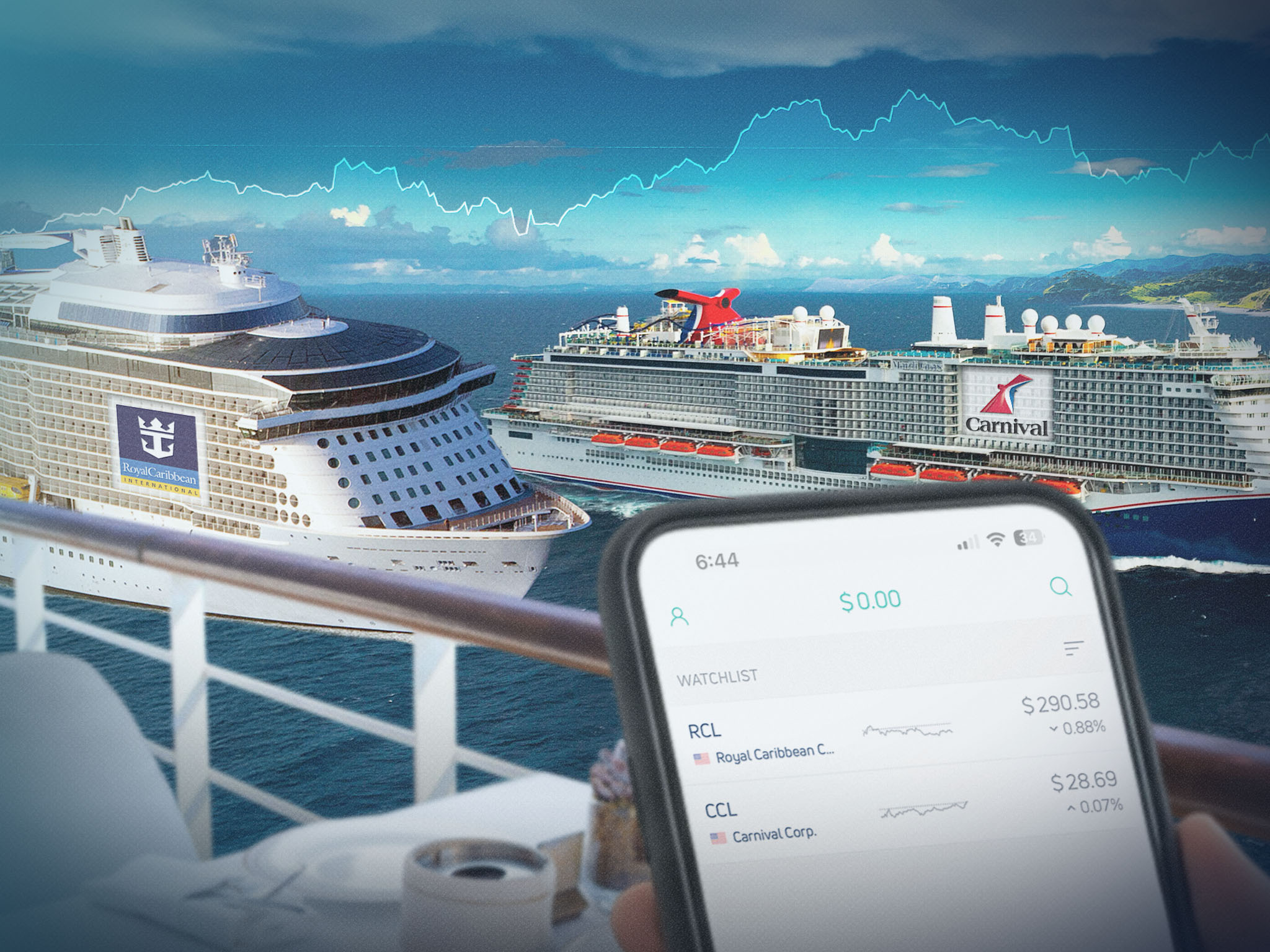


It’s smooth sailing for the cruise industry now, as consumers continue to travel, prices continue to rise and cruise companies continue to reinvest in their businesses.
The world’s two biggest cruise companies (with the No. 1 and No. 2 ranking dependent on the metric) are Carnival (NYSE: CCL) and Royal Caribbean (NYSE: RCL). They’re both headquartered in the U.S.
Carnival has generated total annualized returns of 11.5% over the past one year and 38.6% over the last three years. Royal Caribbean’s numbers are 21.6% and 66.1%. Carnival has a market capitalization of $37 billion, compared to $80 billion for Royal Caribbean.
Cruising went dormant after the Covid pandemic broke out in early 2020, as ships full of people were like petri dishes for the disease. But the industry didn’t take too long to rebound. The number of Americans cruising hit 20.7 million last year, a record high for the third straight year, estimates AAA Travel agency. And it predicts another increase to 21.7 million this year.
Cruises are available at a wide range of prices and generally cost only 50% to 75% as much as land-based vacations. That discount may shrink, as Carnival and Royal Caribbean both are sporting record-high cruise prices and are likely to raise them further, with customers apparently willing to pay up.
Strong metrics for Royal Caribbean
Premium pricing and strong expense controls should push Royal Caribbean’s return on invested capital to 26% in 10 years from an estimated 17% in 2025, according to Morningstar analyst Jaime Katz. That’s far above her projection for a 10% average cost of capital.
“Royal Caribbean has carved out a compelling position in cruising thanks to its contemporary brand and compelling destinations, key factors that support price improvement and our narrow moat rating,” she said. A narrow moat rating means she thinks the company will maintain its competitive advantages for at least 10 years. (She also has a narrow moat rating for Carnival).
Royal Caribbean also benefits from its private island Coco Cay in the Bahamas. To be sure, Carnival has matched that, opening a private island of its own last year, Celebration Key, also in the Bahamas.
Carnival enjoys the biggest global fleet of ships with more than 90. “Carnival’s ability to reposition and redeploy ships to faster-growing and under-represented regions like Asia-Pacific has helped balance the supply in high-capacity regions like the Caribbean and Mediterranean,” Katz said. “That’s a factor the firm can mobilize to help optimize forward pricing.”
She forecasts that Carnival will attain a 22.5% ROIC 10 years from now compared to a 10% weighted average cost of capital.
Royal Caribbean’s stronger stock
Given the strengths of both companies, you might wonder why Royal Caribbean’s stock has vastly outperformed Carnival’s. Artificial intelligence service Grok offers several explanations using trailing 12-month financial data (through Sept. 30 for Royal Caribbean and through Aug. 31 for Carnival).
Royal Caribbean’s profit was 54% bigger ($4.07 billion vs $2.64 billion), even though its revenue was 34% lower ($17.44 billion vs $26.23 billion). That points to Royal’s superior pricing power and cost control. Royal Caribbean’s premium-priced ships include the Icon Class, the largest cruise ships ever built.
Also, Royal’s net profit margin was 23.3% during the one-year period, compared to 10.1% for Carnival. That reflects Royal’s higher profit yields per passenger and efficient operations, Grok notes.
In addition, Royal had an ROIC of 15.2%, compared to 13% for Carnival. So it’s no wonder that Royal’s long-term debt was 37% lower than Carnival’s ($17.2 billion vs $27.2 billion).
Still, it looks like calm waters ahead for both companies.


Comments