


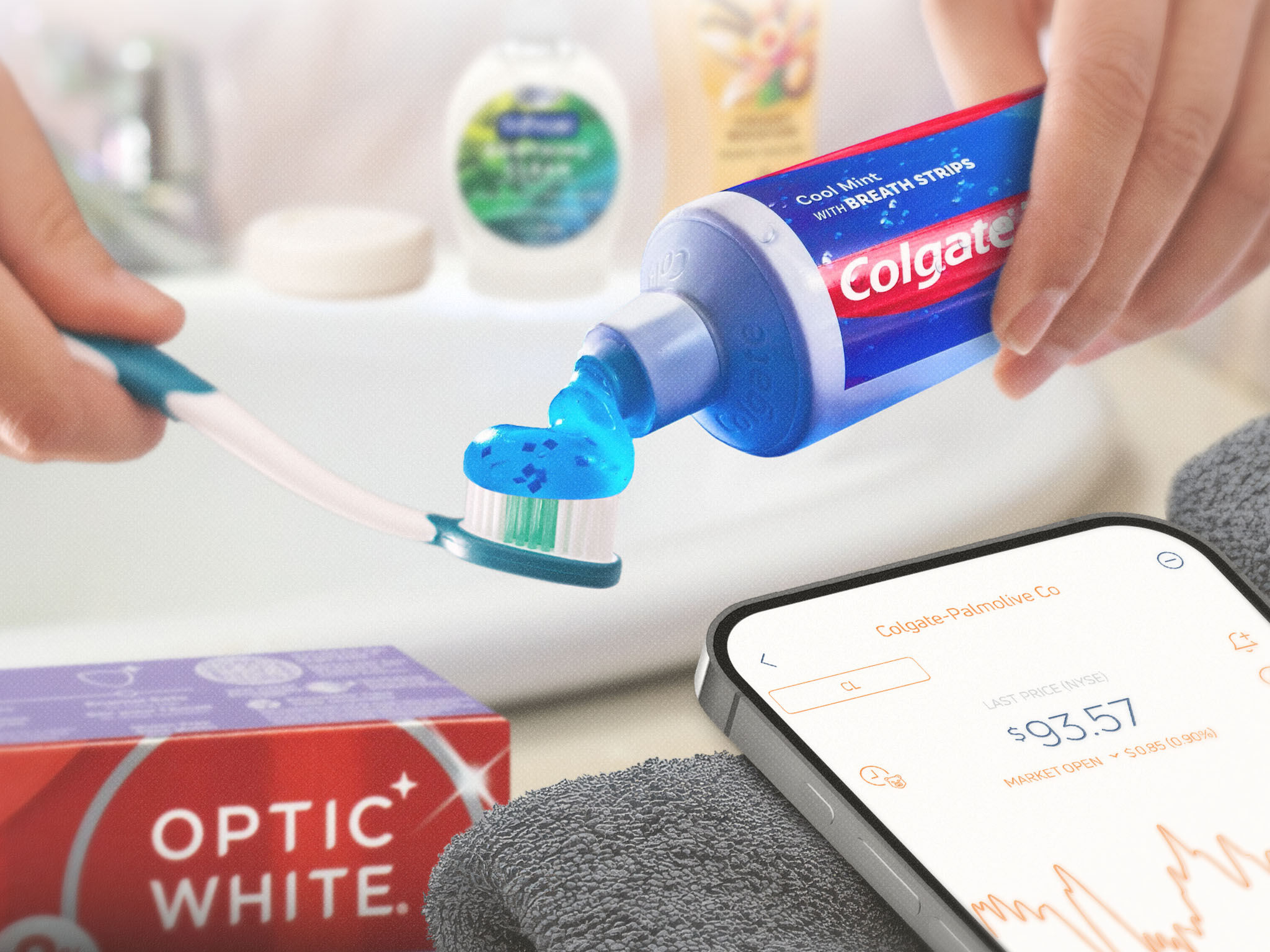


Colgate-Palmolive (NYSE: CL), the U.S. household products stalwart, may represent an island of stability in a stock market driven by volatility in the technology sector.
Oral care, including Colgate toothpaste, toothbrushes, and mouthwashes, represents the 220-year-old company’s largest business. It accounts for about 40% of Colgate-Palmolive’s sales. And the company leads the world in market share for toothpaste (41%) and manual toothbrushes (32%).
Another Colgate-Palmolive division is personal care products, including soaps such as Softsoap, shampoo and deodorant such as Speed Stick. Then there’s the household products division that includes Palmolive dishwashing detergent and Ajax, which encompasses a number of cleaners. Finally, the company has a petfood segment, Hills, that makes up 23% of its revenue.
Colgate thrives with shrewd programs and generous spending for research, development (including digital development) and marketing, wrote Morningstar analyst Erin Lash. It also responds quickly to evolving consumer preferences.
“While concerns abound regarding consumers’ financial health and their willingness to pay up for the essential goods in Colgate-Palmolive’s portfolio, the firm is navigating the uncertain landscape astutely,” she said.
The company’s sales, development and marketing spending total 14% of sales. Lash believes this trend will continue over the next 10 years.
White teeth and fresh breath
On the innovation side, Colgate has offered Optic White teeth whitening products for the past 15 years, regularly adding new versions. There’s also Colgate Total Active Prevention, which includes toothpaste, toothbrushes and mouthwash. The company says it products reduce bacterial plaque better than competitors. The system was introduced last year.
On the marketing side, Colgate has put a heavy focus on digital, with programmatic advertising, data-driven targeting, automation in media buying, and advanced measurement tools. Last year it began a Make More Smiles rebranding campaign, positioning the smile as a symbol of optimism, health, and belonging.
Colgate is particularly strong in emerging markets, which provide almost half of its sales. Even though it’s U.S.-based, Latin America is its No. 1 market, giving 24% of its revenue. It has a 66% share of the toothpaste market in Brazil, and 43% in India.
Healthy earnings
Colgate reported solid earnings for the fourth quarter, with net sales rising 5.8% from a year earlier to $5.2 billion. To be sure, net income swung to a $37 million loss from a $739 million gain last year.
But that reversal largely stemmed from a $794 million charge in the company’s skincare business. The charge resulted from lower-than-forecast growth rates in the industry and worse-than-forecast performance, especially in China.
In any case, Colgate predicts its revenue will climb 2% to 6% for all of 2026. Investors appeared to like the earnings report, pushing the stock up 11% since it was released Jan. 30. The stock has generated an annualized total return of 12% for the past 12 months and 6% for the last five years.
The short term looks cloudy for Colgate. “The geopolitical environment, including tariffs, is volatile, particularly in Latin America, and the U.S. market remains sluggish,” said CEO Noel Wallace. “While we think trends will improve, we’re not building in a big rebound.”
But the long term looks bright. The company’s return on invested capital can continue to surpass its cost of capital over the next 20 years, Lash said.


Comments