


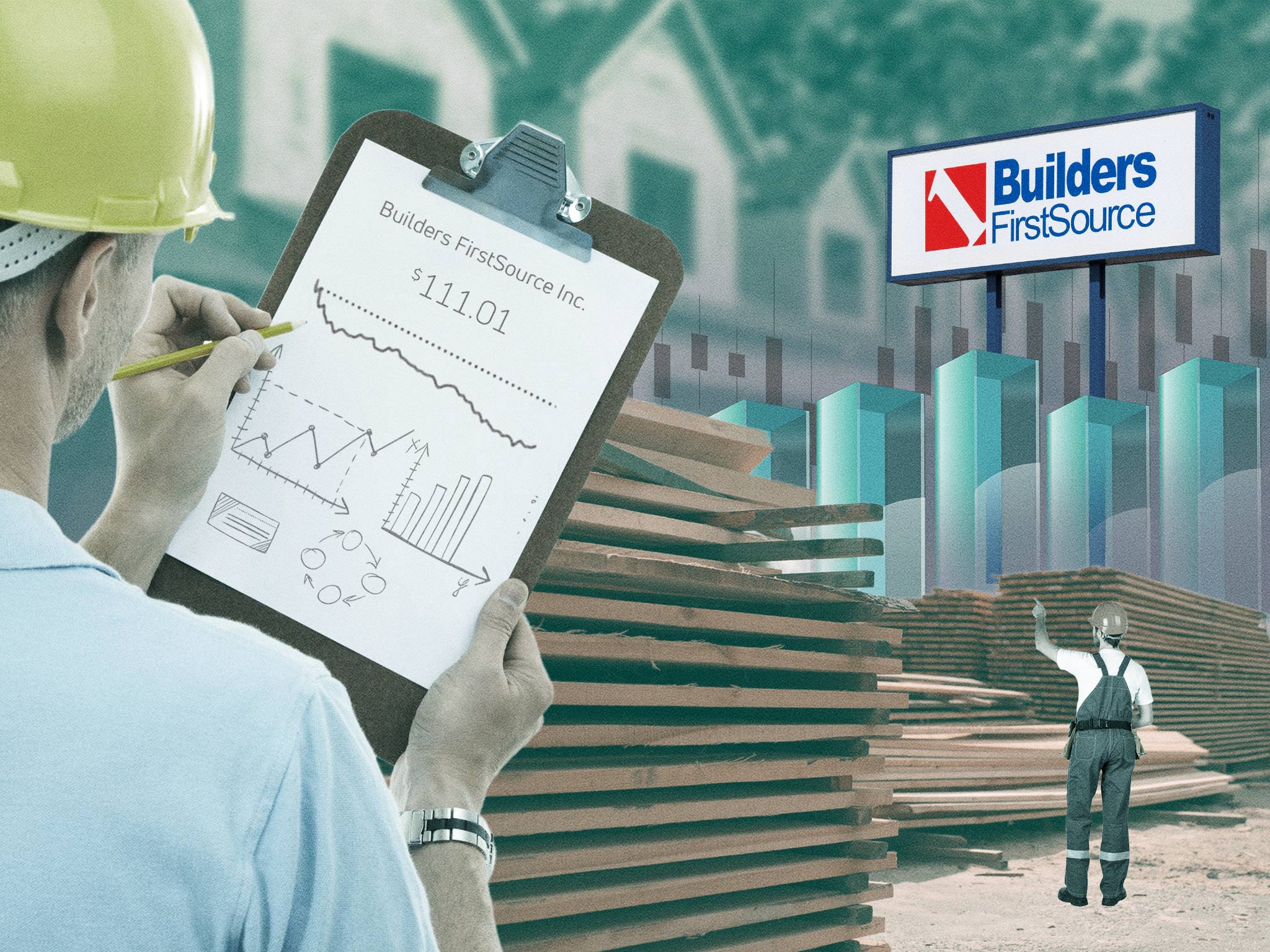


Discussions about housing stocks generally focus on home builders.
But shares of Builders FirstSource (NYSE: BLDR), the largest U.S. building materials supplier for the home market, have outperformed home-builder stocks long-term.
Over the past five years, Builders has generated an annualized total return of 26%, and over the past 10 years, it’s 24%. That’s far ahead of S&P Homebuilders Index, which has returned 15% annualized over five years and 13% over 10 years.
To be sure, weak housing starts data stubbornly high mortgage rates, and falling lumber prices have hurt Builders. Starts dropped 3.9% in 2024, and rebounded only 0.7% through the first eight months of this year from the same period of last year.
Wood prices have fallen 8% in the last year, lessening the value of Builders’ lumber sales. And the 30-year fixed mortgage rate stands at 6.23%, not a huge drop from 6.81% a year ago.
Looking at Builders’ earnings, revenue fell 6.9% in the third quarter from a year ago, profit tumbled 57%, and gross profit margin decreased 240 basis points to 30.4%.
So it’s no wonder that Builders’ stock has slid 38% over the past year. It has a market capitalization of $12 billion.
Factors behind long-term strength
But obviously the company has some marked strengths for its stock to do so well over the past five and 10 years. First, Builders has built a 20% market share, largely through acquisitions, more than twice its nearest competitor. Its largest acquisition totaled $2.5 billion for BMC Stock Holdings in 2021.
That means there’s a lot of market share left for Builders to snap up. “In a market this fragmented, there is still a lot of opportunity to do deals and grow,” Builders CEO Peter Jackson told Barron’s.
And while lumber is an important part of Builders’ business (26% of sales), the company goes way beyond that. “You take technology, process, fixed overhead, and replace skilled labor on the job site,” he said. Trusses, the triangular-shaped formations supporting home roofs are an example.
“It’s an important load-bearing component,” Jackson noted. “Historically, it’s where a lot of folks would over-engineer. They’d throw in a few more boards.”
But now Builders can use software to design custom-engineered plates to hold the connections together where the two pieces of board meet. “The precision, the quality can be better than on the job site, and it’s a lot faster. It allows us to capture a nice margin while still providing a nice value for the builder.”
The bullish case for Builders
Jack Hough of Barron’s outlined the bullish case for Builders succinctly last year. “The pitch is straightforward,” he said. “Factory construction of house components saves weeks’ worth of on-site labor and cuts down on wasted wood.”
The company’s dominant scales allows it to “turn out floor and roof trusses, pre-hung doors, wall panels, and more,” Hough points out. “Its customers include most of the big builders, and its software and logistics can help smaller builders appear more polished.”
The long-term outlook for housing demand appears solid. Studies indicate the U.S. has a shortage of 4.5 million-4.7 million homes. More building means more demand for Builders’ products.
Also, the shortage of skilled labor, due largely to the expulsion of immigrants, has added two months to the construction time for a new house. That’s quite significant, given that the average time to build a new home is seven to eight months. Some of Builders’ products can lessen the need for skilled workers.
So the company may have bright days ahead. But remember, nothing is guaranteed.


Comments