


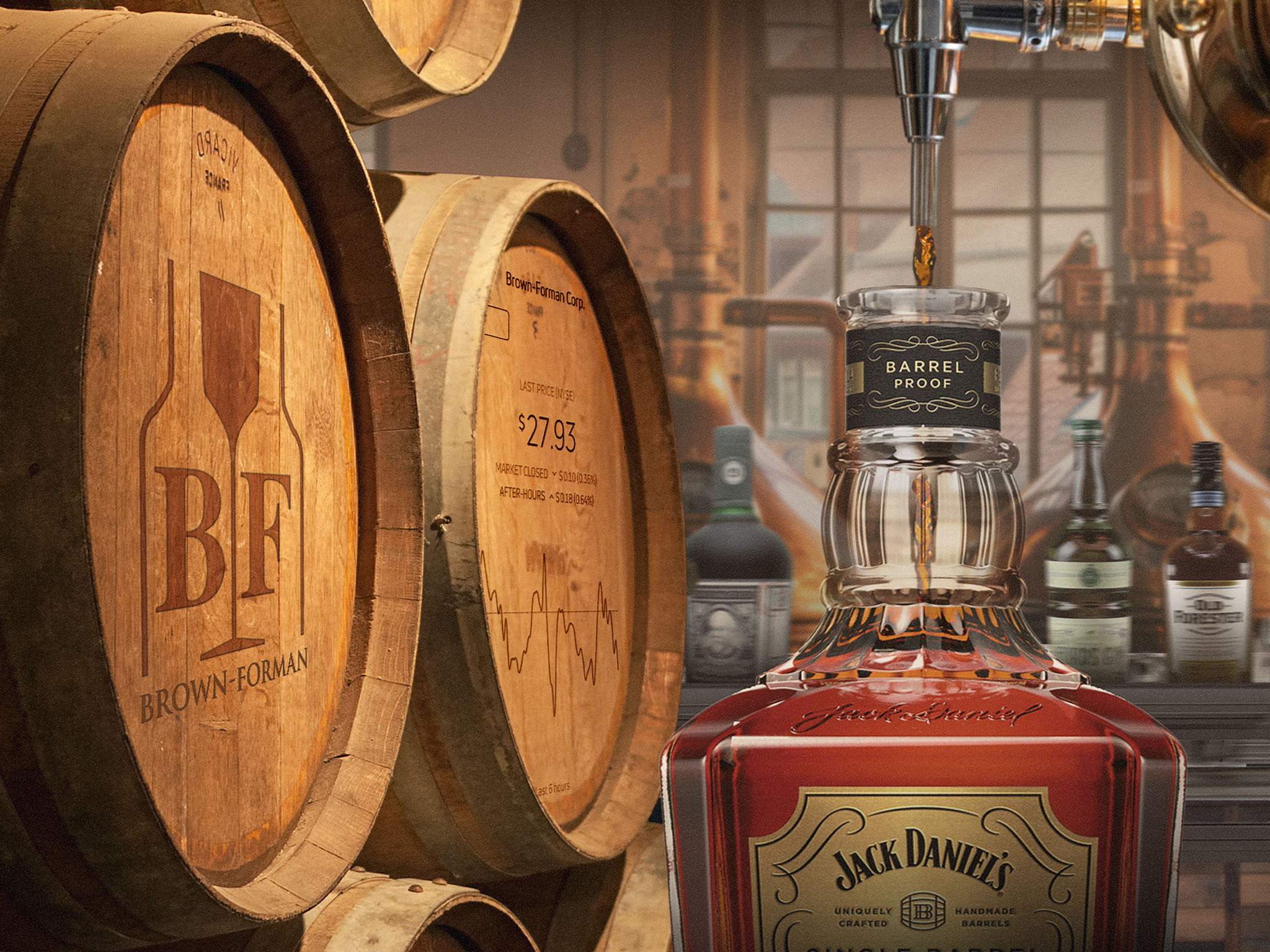


Jack Daniels whiskey is so iconic that rock star Billy Joel’s 1973 song “Captain Jack” was widely assumed to be about the beverage, even though it was actually about drugs.
But the drink’s prominence hasn’t been enough in recent years to lift the stock of Brown-Forman (NYSE: BF), the company that makes it. The shares have generated negative total annualized returns of 18.1% for the last year, 15.1% for the last five years and 0.1% for the last 10 years.
The company has suffered from waning consumer demand, which resulted from economic stagnation in many parts of the globe and a growing aversion to alcohol amid public health campaigns.
The tariff war that the U.S. began in March also has hurt. In Canada, for example, U.S. alcohol was booted from store shelves in several provinces. Brown-Forman’s organic Canadian sales dropped 60% in the first half of fiscal 2026, ended Oct. 31, from a year earlier.
In addition to Jack Daniels, Brown-Forman’s brands include Old Forester bourbon, Herradura tequila, Diplomatico Rum and Fords Gin. The company is the world’s biggest whiskey seller, with a 35% share of the U.S. market.
Brown-Forman’s revenue slid 5% in the quarter ended Oct. 31 from a year earlier and operating income fell 10%. To be sure, the company’s gross profit margin climbed to 59.3% from 59.1%. That increase stemmed partly from Brown-Forman ending its partnership with Korbel Champagne Cellars in June.
Uncertain outlook
Brown-Forman CEO Lawson Whiting warned in December that the hardship might continue. “The operating environment remains challenging and uncertain,” he said in the earnings conference call.
That includes “cyclical pressures related to ongoing macroeconomic and geopolitical uncertainties, which have negatively impacted consumer confidence and reduced discretionary spending in the U.S. and many developed international markets,” Whiting said.
For all of fiscal 2026, the company predicts that organic sales and operating income will fall in a low-single-digit range. Not surprisingly, Whiting is more optimistic about the long term. “We expect cyclical headwinds to ease over time while acknowledging that some current headwinds may persist.”
One area of strength he cited was emerging markets, which account for about 25% of the company’s sales. Brown-Forman’s organic sales there soared 12% in the six months ended Oct. 31 from a year earlier, led by Mexico and Brazil.
Morningstar analyst Dan Su is extremely bullish on the company long-term. “With over 150 years of distilling experience specializing in Tennessee whiskey and Kentucky bourbon, Brown-Forman has earned accolades and loyalty from consumers for distinct flavors and consistent quality,” she wrote.
High-end advantage
“Its high-end positioning in the structurally attractive whiskey category (where a multi-year aging process creates significant entry barriers) aligns well with the industry’s premiumization trend.”
The company has consistently high gross margins, averaging 60% over the past five years, almost equal to the levels of larger competitors Diageo (NYSE: DEO) and Pernod Ricard (CBOE: RI). That shows consumers are willing to pay a premium price for its popular drinks, Su said.
Su also is impressed with Brown-Forman’s innovation pipeline for whiskey, tequila and the ready-to-drink category. Last summer, the company introduced its latest whiskey, Jack Daniel’s Tennessee Blackberry.
On the ready-to-drink side, Su cited Brown-Forman’s partnership with Coca-Cola for the Jack and Coke premix cocktail, which came out in 2023. That “should allow the distiller to capitalize on demand tailwinds and benefit from Coke’s distribution breath internationally,” he said. And Brown-Forman’s recent entry into gin and rum also could boost sales long-term.
Su forecasts the company will enjoy average annual returns on invested capital of 17% over the next 10 years, compared to a 7% weighted average cost of capital.


Comments