


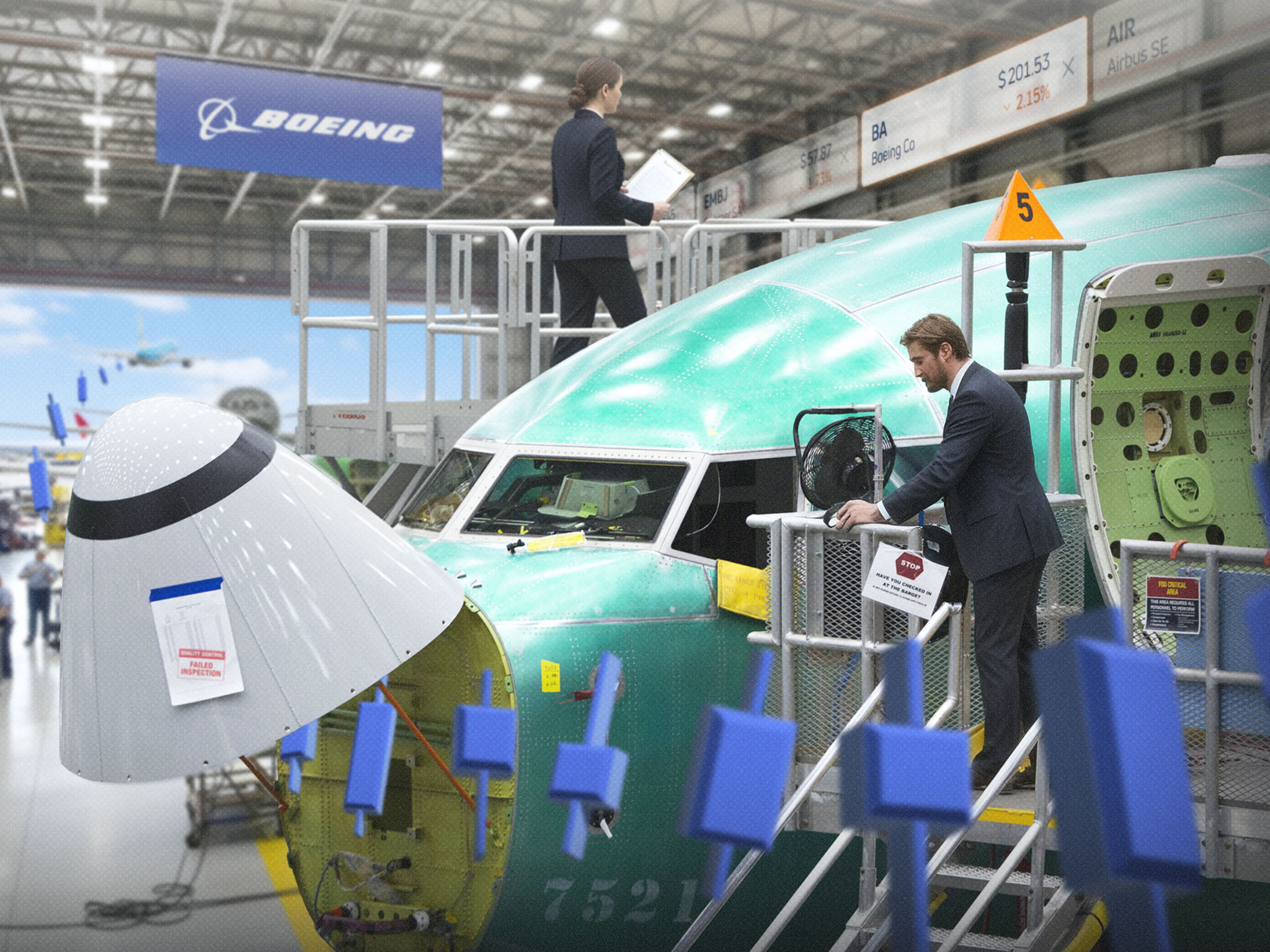


Just when it looked like Boeing (NYSE: BA) had finally turned around from its myriad of woes, the U.S. aerospace giant stepped in it again.
Last week, the company said it would delay deliveries of some 737 Max planes, after finding a flaw on newly-built versions of its flagship narrow-body aircraft. The problem is scratched wiring and it stems from a machining error, the company said. It didn’t say what fixes are necessary or how many planes have the problem.
To be sure, veteran Barron’s writer Al Root predicts the wiring issue will have only “a modest, temporary impact on cash flow.” Boeing said all in-service 737 Max airplanes will continue to operate safely.
The fixes can be completed in days on each plane, the company said. The delay may limit 737 deliveries this month. But Boeing still hopes to ship about 500 of the planes this year.
The stakes are high, as the 737 is key to Boeing’s fortunes. Morningstar analyst Nicolas Owens estimates that half the company’s enterprise value stems from 737s. “Increasing the rate at which the company can make and deliver these jets is the single biggest driver of near- and long-term profitability and cash flow,” he wrote.
Jet troubles
The 737 Max has caused massive difficulties for Boeing, starting with two crashes that killed 346 people in 2018-19. The fleet was grounded in the U.S. in 2019-20. Boeing also has had production problems with its 787 jumbo jet over the years.
Even now, Federal Aviation Administration chief Bryan Bedford said last month that the company needs to do more to regain the ability to certify the airworthiness of its planes and other powers, Bloomberg reports. On the bright side for Boeing, he also said it’s making “great progress.”
The 737 isn’t Boeing’s only problem. Chief Financial Officer Jay Malave said the commercial division’s operating profit margin will drop to about negative 7.5%-8% this quarter, compared to positive 37% in the fourth quarter, The Wall Street Journal reports.
That’s thanks to higher-than-expected costs for the integration of its supplier Spirit AeroSystems. Boeing bought the company last year for $8.3 billion including debt.
In addition, the company faces issues in its defense segment, which accounts for 30% of its revenue. The main problems: poor program execution on fixed-price contracts, severe technical flaws in major systems, and persistent supply chain issues.
Boeing wasn’t always in trouble. For decades, the 110-year-old company was prized for the quality and safety of its planes. There was a popular saying: “If it’s not Boeing, I’m not going.” But the culture ultimately shifted away from a focus on engineering quality toward a focus on short-term profits.
History turns sour
The shift came after the company bought competitor McDonnell Douglas in 1997. That company’s executives took control of Boeing, and they implemented the change.
Harry Stonecipher, a former McDonnell Douglas CEO who led Boeing from 2003-2005, famously said: “When people say I changed the culture of Boeing, that was the intent, so that it’s run like a business rather than a great engineering firm.”
But it was its status as a great engineering firm that made Boeing a great business. So the de-emphasis of top-shelf design and commitment to safety sent the company into a nose-dive. The whole idea was to turbocharge the stock. But since the beginning of 1998 it has gained 305%, compared to 578% for the S&P 500. Boeing shares have slid 8% in the last six months.
The company is too big to fail, as it’s the only major manufacturer of big commercial jets in the U.S., and one of only two in the world along with Airbus (CBOE: AIR).
By all accounts, Boeing CEO Kelly Ortberg, who took office in 2024, is doing a good job bringing Boeing back from the abyss. But the company still has a ways to go.


Comments