


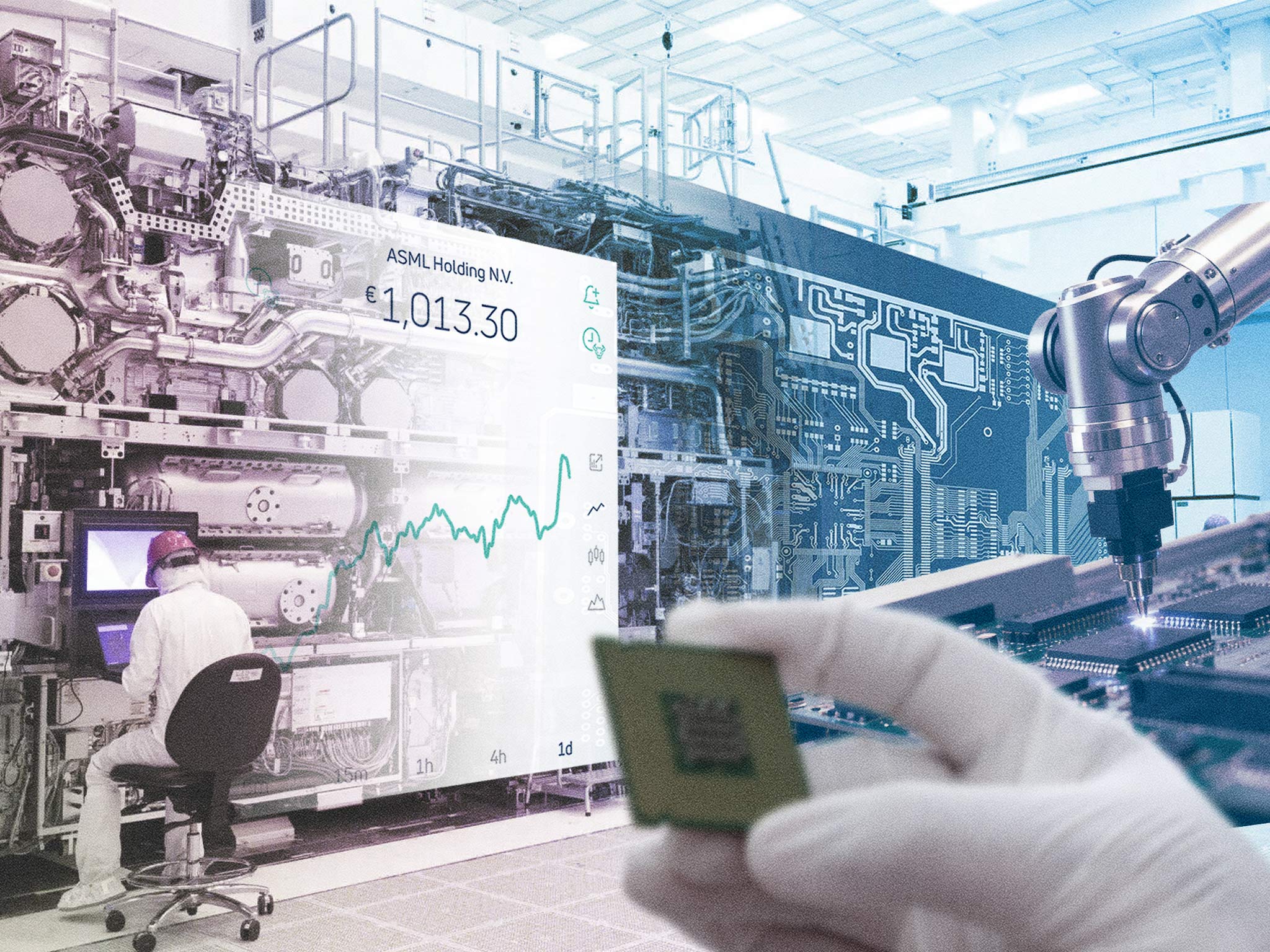


Semiconductor equipment company ASML Holding (CBOE: ASML) is reaping the rewards of the surge in the build-out of artificial intelligence infrastructure as the demand for chips continues to rise.
The Dutch equipment company can take advantage of the demand that is increasing as the number of chips used in devices ranging from smartphones to data centers is not easing.
The company stands out because it manufactures equipment to produce dynamic random-access memory chips, known as DRAM. These chips are used in graphics cards, gaming consoles, laptops, and many other devices. The main manufacturers of memory chips are Micron Technology (NASDAQ: MU) and Asian companies Samsung Electronics and SK Hynix.
ASML’s equipment can also assist in the manufacturing of logic chips that perform operations that are conducted by graphics processing units.
The company will “remain the top lithography equipment provider in semiconductor foundries for the next two decades,” wrote Javier Correonero, an equity analyst for Morningstar.
The expansion of AI being used in numerous industries means that ASML can benefit from the rise in demand of both types of chips – logic and memory.
“While many believe ASML’s growth will be primarily driven by logic, we think the upside from DRAM is significantly underestimated,” wrote David Dai, a Bernstein analyst, who increased its price target to $1,528 from $935 and changed the stock rating to outperform from market perform.
Shares of ASML rose by 50% during the past six months as the company has been the beneficiary of the demand in building more AI models across various industries to generate more efficiency and productivity.
During the third quarter, the company reported strong earnings, with net sales of €7.5 billion (approximately $8.8 billion) on net income of €2.1 billion.
ASML estimates that its fourth quarter revenue will generate between €9.2 billion and €9.8 billion, with a full-year 2025 total net sales increase of around 15% relative to 2024.
The company’s revenue could increase by 6% in 2026 and grow by 10% to 12% through 2030, Dai of Bernstein said.
Although ASML has predicted that its sales in China are expected to decline this year, it believes that after 2027 the decline will stop. In China, the capacity for advanced logic chips is estimated to increase.
The potential for growth with ASML will only climb as the need for AI will expand, Correonero of Morningstar wrote.
“In addition, no competitor has yet matched ASML’s technological leadership, and we don’t see this happening in the next 10 years. The company’s competitive advantage should keep expanding as it increases its already-high EUR 5 billion research and development budget.”
While ASML’s machines can produce chips for three decades, the company also generates revenue by providing service and maintenance to them.
“ASML’s EUV machines are more complex than the previous deep ultraviolet, or DUV, generation, meaning higher potential for service revenue,” Correonero wrote. “Management expects to increase service margins in the next decade as it focuses more on this segment and launches more complex machines. Software and hardware upgrades are also high-margin, although these can be more cyclical, since the foundry needs to stop production to implement them.”
As more large language models are developed, resulting in the construction of more data centers, the number of industries seeking more efficiency and adopting the use of AI will rise exponentially.


Comments