


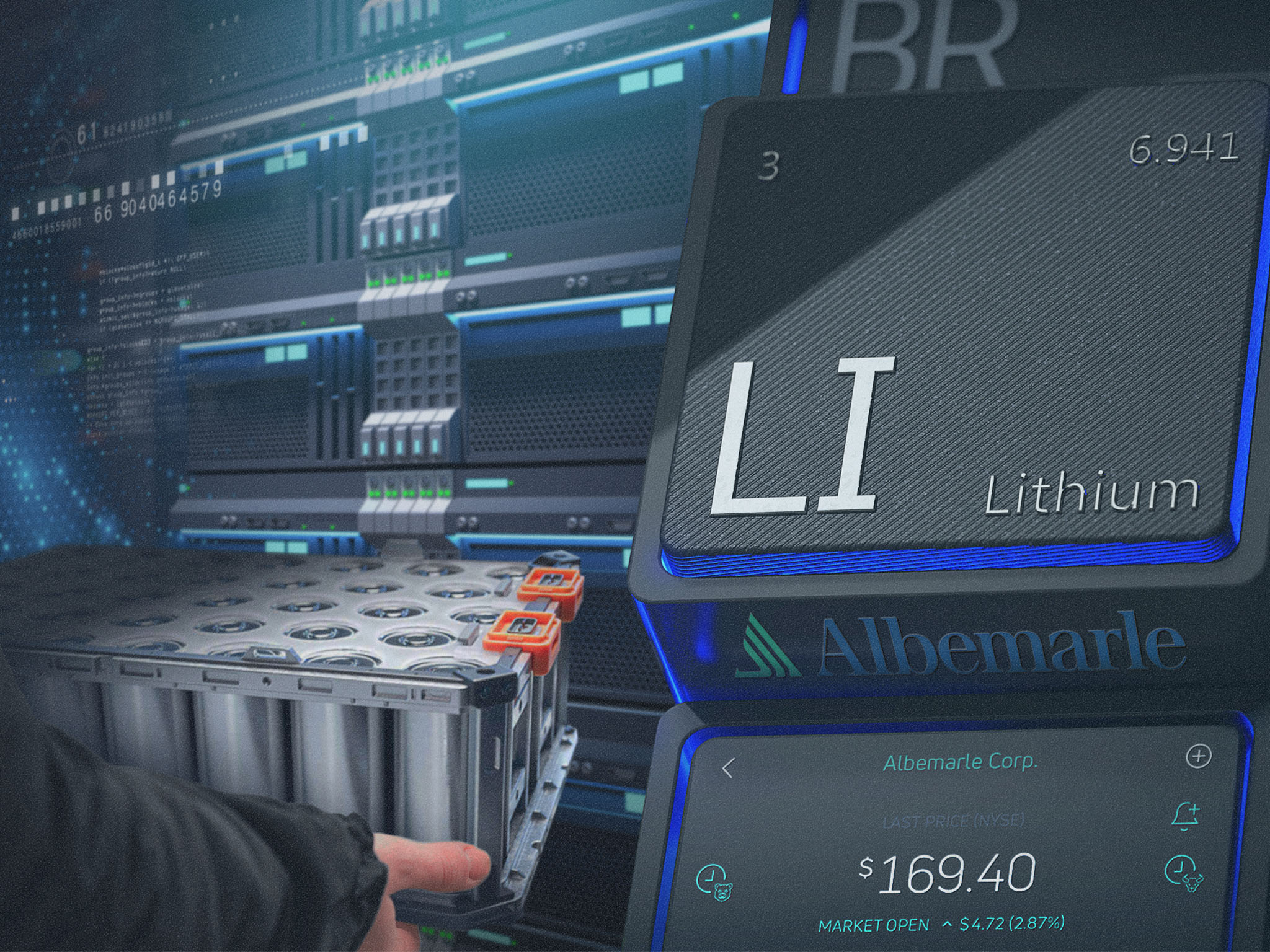


Metals and chemicals conglomerate Albemarle (NYSE: ALB) is reaping the rewards of rising lithium prices as demand for energy storage in data centers continues to skyrocket.
A supplier of bromine and one of the largest lithium producers globally, Albemarle will benefit from lithium reaching over $24,000 per metric ton after falling to a four-year low of $8,000 a ton in 2025.
Constraints in lithium market
Lithium prices rose recently when the Zimbabwe government said on Feb. 25 it would impose a ban on exporting lithium concentrate, raising concerns about a lower supply, according to Reuters.
While the news was positive for shareholders of Albemarle, Zimbabwe “accounted for less than 5% of global lithium mining production in 2025 on a lithium carbonate equivalent basis,” wrote Seth Goldstein, a senior equity analyst for Morningstar. “That said, banning exports creates a supply shock as the market was in balance and will now likely move to undersupply in the near term.”
During the past few months, prices for the metal that is used in batteries have “roughly doubled,” he added. Lithium prices are estimated to remain at $20,000 per metric ton based on the “marginal cost of production,” Goldstein said.
Albemarle’s profits and cash flow will improve due to these higher prices, especially as demand continues to rise for energy storage.
“We forecast energy storage (lithium sold to batteries) segment profits will roughly triple in 2026 versus 2025,” he wrote. “This should also drive much-improved free cash flow generation for the company.”
But investors should expect prices to “remain volatile” due to boom and bust cycles, but will average around the marginal cost of production over the long term, Goldstein said.
Used to manufacture batteries for consumer electronics and electric vehicles, lithium is a critical metal. Since 2020, prices for lithium have moved sharply in both directions. While prices skyrocketed in 2021 and 2022, they dropped swiftly when demand for EVs slowed down, and consumers replaced their smartphones and laptops at a slower pace.
Shares of Albemarle have shot up by 155% in the past year as lithium prices have followed suit.
Albemarle reported fourth quarter net sales of $1.4 billion, an increase of 16% while volume rose 12%, including gains in all segments, led by energy storage, which grew by 17%, and Ketjen, which was 13%. In the fourth quarter, benchmark spot lithium prices averaged $9,500 per metric ton, compared to $8,500 a year ago.
The company reported a net loss of $414 million, which included tax-related items and the write-down of assets due to the expected Ketjen transaction value. Albemarle is expected to close on the sale of its 51% stake in Ketjen, its catalysts business, to KPS for $660 million in the first quarter of 2026. The company also closed its sale of a 50% stake in the Eurecat joint venture for $123 million in cash in January 2026.
But Albemarle reported adjusted EBITDA of $269 million, which grew by 7%, led by energy storage that increased by 25% and Ketjen that rose by 39%.
The company, which is also a large supplier of bromine that is used for agricultural products and for flame-retardant items, has been working to slash operating costs and achieved $450 million of cost and productivity improvements, exceeding the initial target of $300 to $400 million.
“Albemarle achieved year-over-year sales growth of more than 15% in the fourth quarter, as well as strong full-year cash flow generation and significant cost and productivity improvements,” said CEO Kent Masters. “Even as market conditions improve, we continue to drive cost reduction and productivity actions to enable long-term growth.”
Higher global demand
Global lithium consumption from energy storage is anticipated to increase by 45.6% in 2030 from a 2025 estimate, said S&P Global Energy CERA analysts.
Higher demand is expected to drive more revenue for Albemarle, especially as more EVs, which are the biggest consumers of lithium, are sold, and as more data centers are being constructed to meet the AI computing expansion.
Albemarle estimates generating revenue of $5.7 billion to $6 billion and earnings before interest, taxes, depreciation, and amortization, or EBITDA, of $2.4 billion to $2.6 billion if lithium prices average $20,000 per metric ton.
“We also see global EV sales growing, which will raise lithium demand,” Goldstein said at the S&P Global Energy on Dec 5. “Due to demand growing faster than supply in 2026, we see the market moving from oversupply closer to balance by the end of the year.”
Grid-scale storage is also anticipated to increase, especially as the need to build out infrastructure for data centers grows.
“We expect battery energy storage systems will see mid-double-digit growth in 2026 and continue to be the fastest growing lithium demand source,” he said.
Albemarle has estimated that the amount of lithium being used for energy storage will jump by 90% year over year. In the U.S., growth in energy storage rose by 145% year over year through September.
“We expect lithium demand for stationary storage applications to increase more than 2.5 times by 2030,” said Masters on a Nov. 6 earnings call.
The fastest growing region that is demanding energy storage in North America, as “rising data center and AI investment in the United States increases the demand for electricity and grid stability,” he said.
As the demand for AI computing continues to rise quickly and the sale of EVs increases globally, Albemarle will benefit from the need for more lithium being used in batteries to store power.


Comments